
Some home jobs you should absolutely do yourself. Some you should absolutely not. And a big middle group depends on your tools, your time, your tolerance for risk, and how much it will cost to fix if it goes sideways. This is a practical, job-by-job guide to deciding when to grab the drill and when to call a handyman — written by the people who get the "I tried to do it myself and now it is worse" calls.
The 5-Question Test: DIY or Pro?
Before you start anything, run it through these five questions. Three or more "pro" answers means call someone.
- What happens if it goes wrong? A crooked shelf is annoying. A TV that pulls out of the wall, a flooded bathroom, or a fall off a ladder is not. Higher stakes → pro.
- Does it touch water, gas, electrical, or structure? Like-for-like fixture swaps can be DIY; new wiring, new plumbing, gas, or anything load-bearing is not — and some of it legally requires a licensed trade. See what a handyman can legally do in New York. Touches the big systems → pro.
- Do you own the right tools — and know how to use them? Buying a $180 tool for a one-time job, badly, is false economy. No tools / no practice → lean pro.
- How visible is the result? A patch in the garage can be rough. A patch in the front hallway needs to disappear — and seamless drywall, paint matching, and tile take real practice. High-visibility finish → pro.
- What is your time worth, and do you actually have it? A "Saturday project" that eats three weekends and still is not right costs more than the quote did. No time / it has been on the list for a year → pro.
Almost Always Fine to DIY
Low stakes, common tools, forgiving if imperfect:
- Hanging lightweight pictures and small shelves
- Spackling small nail holes and touch-up painting
- Swapping a toilet seat, a showerhead, or a faucet aerator
- Replacing cabinet knobs and pulls
- Changing HVAC filters, smoke-detector batteries, and light bulbs
- Caulking a tub or sink (if you are patient and tape it off)
- Basic furniture assembly with good instructions
- Weatherstripping a door, installing a door sweep
- Tightening hinges, handles, and toilet bolts
- Cleaning gutters from a stable ladder at single-story height
- Replacing a worn toilet flapper or fill valve
If you enjoy this stuff, have an afternoon, and the downside of a wobbly result is "redo it" — go for it. Our homeowner's guide to minor plumbing fixes and picture-hanging tips are good starting points.
Usually Worth Hiring Out
Doable in theory; in practice the tools, the finish quality, the risk, or the time tip it toward a pro. Here is the honest breakdown:
| Job | DIY difficulty | Risk if it goes wrong | Why most people hire it out |
|---|---|---|---|
| Mounting a TV (especially plaster or brick, 65 inch and up, hidden cables) | Medium–High | Cracked wall, dropped TV, damaged in-wall cable | Stud and anchor selection on old walls; clean cable routing; getting it dead level. TV mounting |
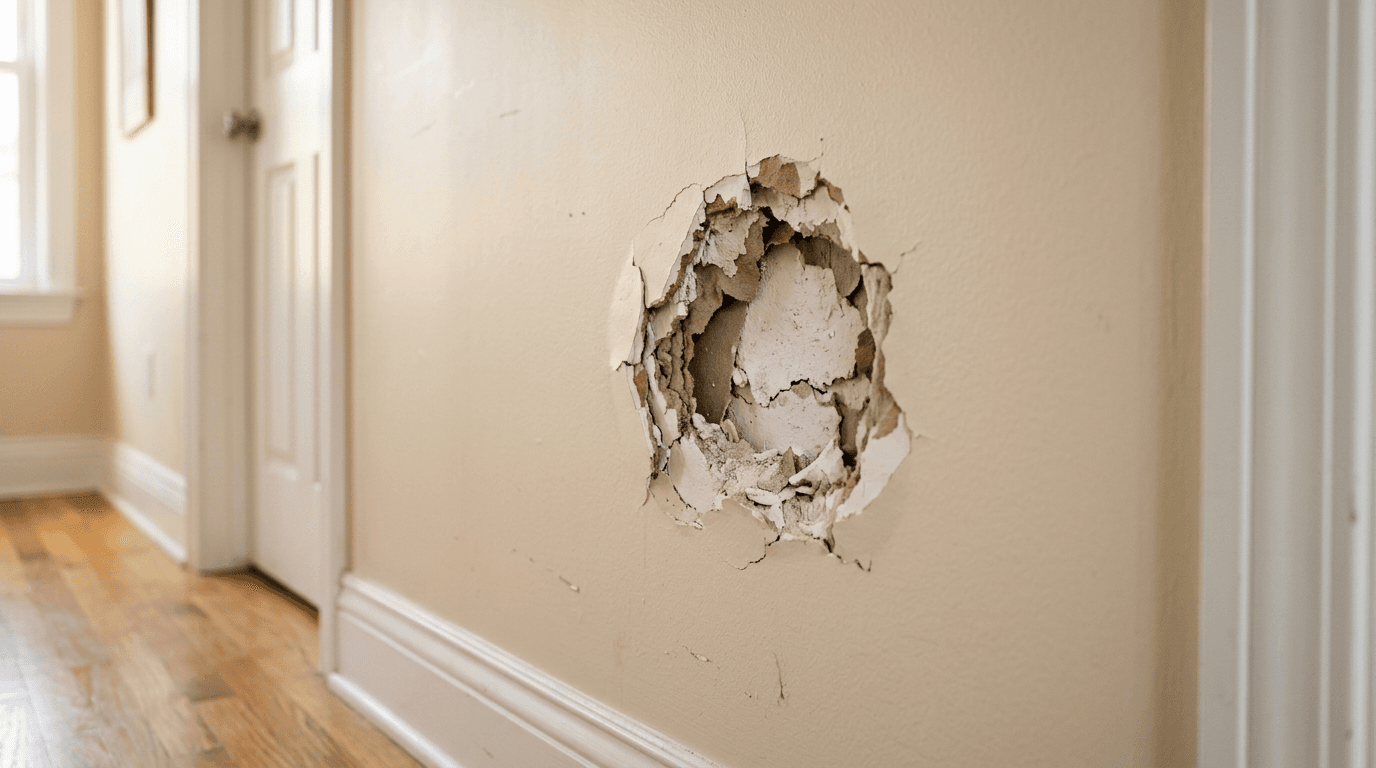
| Drywall patch larger than a few inches | Medium–High | Visible bulge, mismatched texture, cracking | Backing, mesh, multiple feathered coats, texture and paint matching. Drywall repair — and when drywall needs a pro |
| Painting a full room (ceiling, trim, and walls) | Medium | Drips, lap marks, taped-line bleed, ceiling mess | It is mostly prep and patience; pros are 3 to 4 times faster and the lines are crisp. Painting — touch-ups vs. full room |
| Hanging a heavy mirror or large gallery wall | Medium | Mirror down the wall, anchors blown out | Weight ratings, finding studs in plaster, a layout that looks intentional. Picture hanging |
| Installing a pre-hung interior or exterior door | Medium–High | Door will not latch, drafts, out-of-square reveal | Shimming plumb and square in an old, shifted opening. Door installation — what homeowners need to know |
| Tile backsplash or small floor | High | Lippage, bad grout lines, cracked tile, water intrusion | Layout, cutting, setting flat, sealing — mistakes are permanent. Tile work |
| Installing luxury vinyl plank or laminate flooring | Medium | Gaps, peaking, transitions that trip people | Acclimation, expansion gaps, undercutting jambs, clean transitions. Flooring |
| Replacing a light fixture or ceiling fan | Medium | Shock risk, fan wobble, fixture falls | Box rating (fans need a fan-rated box), safe make-up, balancing. Light fixtures and ceiling fans |
| Replacing a toilet or vanity | Medium | Slow leak, rocking toilet, water damage | Wax-ring seal, level set, supply connections that do not weep. Bathroom work — common bathroom fixes |
| Deck board and railing repair | Medium–High | Wobbly rail, soft board underfoot, hidden rot spreading | Matching lumber, proper fasteners, catching the rot you cannot see. Deck repair — warning signs |
| Fence post reset or panel replacement | Medium | Leaning fence, gate that will not close, property-line issues | Setting posts plumb, concrete, matching panels, gate alignment. Fence repair — repair vs. replace |
| Closet system or built-in shelving | Medium | Sagging shelves, units pulling off the wall | Load-bearing layout, level runs, anchoring into framing. Closet systems and built-ins |
| Crib, bunk bed, or complex assembly | Low–Medium | An unstable bed, which is a safety issue with kids | Time, fiddly hardware, and getting it actually solid. Furniture assembly |
None of these are impossible for a handy homeowner. But this is exactly the list a handyman does every week — and "every week" is the difference between a result you notice and one you do not.
Call a Pro, No Exceptions
These are not judgment calls — safety, code, or scale takes them off the DIY table entirely. Some legally require a licensed trade:
- New electrical wiring, panel and service work, hardwiring appliances — licensed electrician
- New plumbing supply or drain lines, relocating fixtures, water heaters, any gas work — licensed plumber
- Removing or altering a load-bearing wall, framing changes, foundation work — general contractor or structural engineer
- Roofing and anything that requires being up on a steep roof — roofer (we do not do roofing)
- Anything two stories up on a ladder, near power lines, or that you would describe as "kind of sketchy" — pay someone with the right equipment and the insurance
For the legal-scope details, see what a handyman can legally do in New York. The short version: a handyman can swap a fixture on existing wiring or piping; a handyman cannot run new systems — and will not pretend otherwise.
The "Honey-Do List" Strategy: Bundle and Done in a Day
Here is the move most homeowners miss. You do not have to choose between "DIY the whole list over six months" and "hire out one job." Do the genuinely easy stuff yourself, then save the rest — the medium jobs, the awkward jobs, the ones you keep not getting to — and have a handyman knock the whole batch out in one visit. It is dramatically cheaper per task than calling for each one separately (one trip, one setup, one cleanup), and your list goes from "someday" to "done" in an afternoon. See how handyman pricing works for why bundling is the single biggest cost lever.
A classic one-visit bundle: mount the TV, patch and paint the two drywall dings, fix the sticking bedroom door, swap the dated dining-room fixture, re-caulk the hall bathroom, tighten the deck railing, hang the gallery wall, assemble the new dresser. That is a normal day for us — see common handyman jobs before selling a home and small repairs homeowners put off too long for more bundle ideas, or browse the full list of 130+ handyman jobs.
What DIY Mistakes Cost to Fix
Some real categories of "we will be there in a couple days" calls — and roughly what the redo runs in 2026 (full pricing in our Rockland County handyman pricing guide):
- Blown-out drywall anchors / a TV that came down — re-back, re-patch, re-paint, remount: often $300 to $600 or more, vs. the $200-ish it would have been done right.
- A drywall patch that telegraphs through the paint — sand back, re-skim, re-texture, repaint the wall: $250 to $500.
- A toilet set without a fresh wax ring — pull it, reset it, and (if it leaked a while) repair the subfloor: $325 to a lot more if there is rot.
- A door hung out of square — re-shim and rehang, or replace a door that got chewed up forcing it: $135 to $475.
- Tile with lippage and bad grout lines — there is no fixing it; it is a tear-out and redo: $1,000 or more.
- A deck "repaired" with the wrong fasteners or over hidden rot — redo plus the spread of the rot you covered: $600 to $1,500 or more.
The pattern: the redo almost always costs more than the original job would have — sometimes a lot more. If a job is on the "usually worth hiring out" list and the result will be visible or load-bearing, the math usually favors getting it right once.
Frequently Asked Questions
Should I hire a handyman or do it myself?
Run it through five questions: What happens if it goes wrong (higher stakes → pro)? Does it touch water, gas, electrical, or structure (yes → pro, and some of it legally requires a licensed trade)? Do you own and know how to use the right tools (no → lean pro)? How visible is the finished result (front-hallway visible → pro)? Do you actually have the time, or has it been on the list for a year (no time → pro)? Three or more "pro" answers means call someone. Small, low-stakes, forgiving jobs are great DIY; visible, risky, or system-touching jobs usually are not.
What home repairs should you never DIY?
Anything requiring new electrical wiring or panel work, new plumbing supply or drain lines, gas work, structural changes (load-bearing walls, framing, foundations), roofing, and anything that puts you two stories up a ladder or near power lines. Some of these legally require a licensed electrician, plumber, or general contractor in New York. A handyman can do like-for-like fixture swaps on existing systems, but new systems are off-limits — and a good one will tell you which is which.
Is it cheaper to DIY or hire a handyman?
For genuinely simple jobs you can do well — picture hanging, knob swaps, filter changes, touch-up paint — DIY is cheaper, full stop. For medium jobs, the math flips more often than people expect: buying a tool you will use once, redoing a visible mistake, or losing three weekends frequently costs more than the quote. And bundling several jobs into one handyman visit is far cheaper per task than the time (and tool runs) of doing them piecemeal yourself.
What is the most common DIY mistake handymen get called to fix?
Drywall and TV mounting top the list — patches that telegraph through the paint, anchors that pull out of plaster, TVs hung off a single drywall anchor. Close behind: doors hung out of square, toilets set without a fresh wax ring (and the subfloor damage that follows a slow leak), and tile jobs with lippage that cannot be fixed without a tear-out. The theme is that these jobs look simple but the finish quality and the hidden details are exactly what experience buys.
Can a handyman fix a DIY job that went wrong?
Almost always, yes — and it is a big part of what we do. Bring photos, tell us honestly what was tried, and we will tell you whether it is a touch-up, a redo, or (occasionally) "actually that is fine, leave it." It is usually cheaper to call sooner rather than after a second DIY attempt. Send it through our free estimate request or text (908) 461-2688.
Not Sure Which Bucket Your Job Is In?
Send us a photo and a sentence — "is this a me job or a you job?" We will tell you straight, even when the answer is "honestly, you can do that one yourself." For everything else, our estimates are free and in writing: request an estimate or call or text (908) 461-2688. See everything we handle on our services page and where we work on our service areas page.
Odds & Ends Handyman Service is a licensed Rockland County Home Improvement Contractor (License #H-25-600, held by Daniel Kiely / Top Line Property Solutions LLC, d/b/a Odds and Ends Handyman Services) carrying $1,000,000 in general liability insurance. Cost figures are general 2026 estimates, not a quote for your project. We serve the Town of Tuxedo — including Tuxedo Park, Eagle Valley, Southfields, and Sterling Forest — and all of Rockland County, NY: New City, Nyack, Nanuet, Pearl River, Suffern, Spring Valley, Haverstraw, Stony Point, Piermont, Tappan, Sparkill, Blauvelt, Valley Cottage, Congers, Pomona, Airmont, Chestnut Ridge, Montebello, New Hempstead, Sloatsburg, Upper Nyack, Thiells, and Garnerville.
Related