
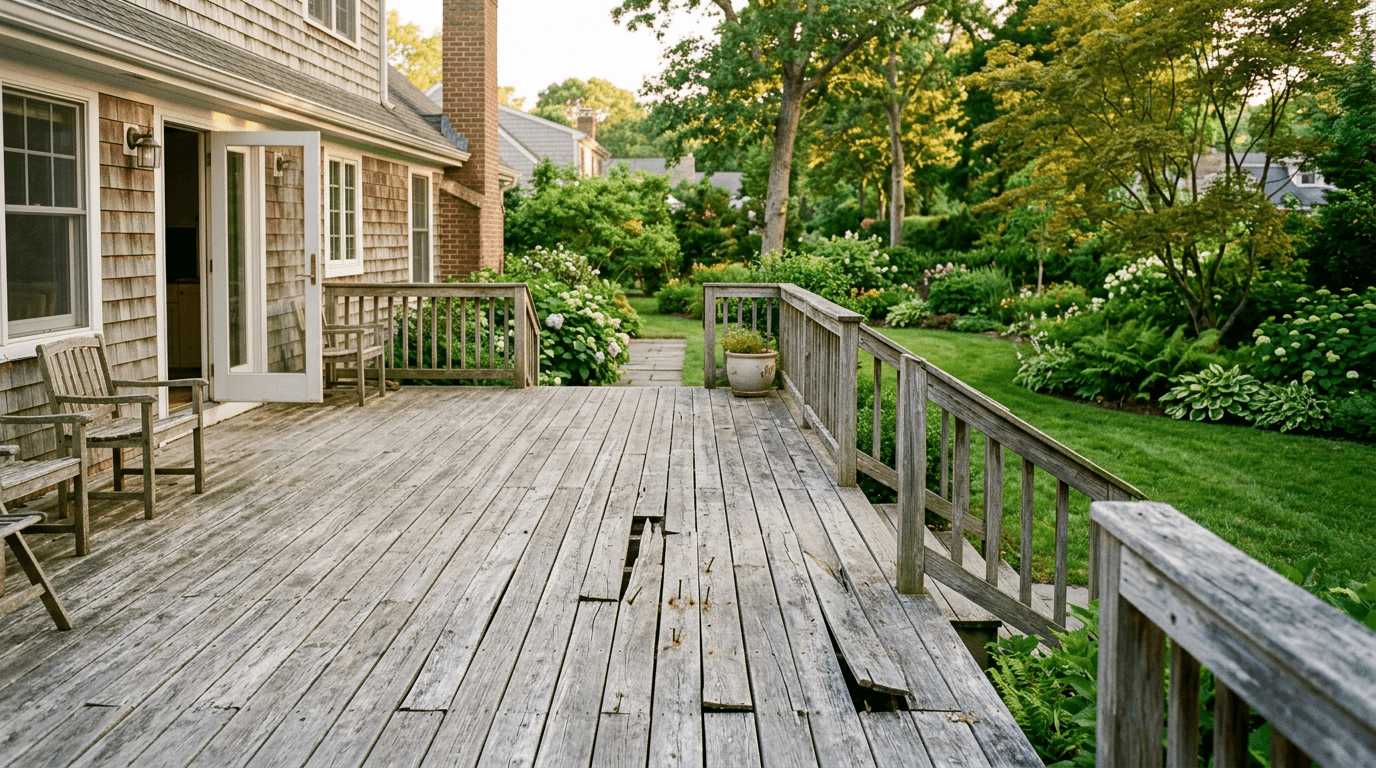
A deck fails quietly. The boards still look fine and the rail still holds — right up until a soft spot gives or a railing lets go. Rockland County decks take a real beating: humid summers, freezing winters, and the freeze-thaw cycle in between. Knowing what to look for keeps a repair small and keeps the deck safe.
Short answer: the warning signs a deck needs repair are soft or spongy boards, loose or popping fasteners, wobbly railings and posts, deep cracks and splintering, a deteriorating ledger board, persistent mold on structural members, water pooling, and age past 20 years without maintenance. The ledger board is the one that matters most — it is the number-one cause of deck collapses.
Why Deck Safety Is Worth a Five-Minute Walk
A deck is a structure that holds people in the air. When one fails, it fails with weight on it. Most failures are not sudden surprises — they are warning signs that got walked past for a season or two. A quick inspection each spring catches problems while they are still a board-and-hardware fix instead of a rebuild.
8 Deck Repair Warning Signs
1. Soft or spongy boards
The biggest red flag. If a board feels soft or flexes more than it should, the wood is rotting from the inside. Poke suspect spots with a screwdriver — if it sinks in easily, that board is done. Rot spreads to adjacent boards and the joists below, so this is not one to wait on.
2. Loose or popping nails and screws
Years of expansion and contraction work fasteners loose. Popping nail heads are a tripping hazard and a sign the boards are moving too much. Old nails can often be upgraded to deck screws for a far more secure hold.
3. Wobbly railings and posts
Give every railing a firm shake. Real movement means the connections have weakened. Railings are a critical safety feature — especially on a raised deck — and a loose one should be repaired immediately, not at the end of the season.
4. Deep cracks and splintering
Fine surface checking is normal in natural wood. Deep splits running through a board, or widespread splintering across several boards, mean the wood is at the end of its life — and a bare-foot hazard for the summer.
5. A deteriorating ledger board
The ledger board attaches the deck to the house, and ledger failure is the number-one cause of deck collapses. Look for gaps between the ledger and the siding, water staining along that joint, rust on the fasteners, or any visible rot. If the ledger looks wrong, treat it as urgent.
6. Persistent mold on structural members
A little surface mold on decking is normal in our climate and cleans off. Mold that keeps coming back on the underside of boards, or on joists and beams, points to trapped moisture — and trapped moisture means accelerating rot.
7. Water pooling
Your deck should shed water after rain. Standing puddles mean boards have warped or the structure has shifted. Pooling water also speeds deterioration and creates slippery spots.
8. Age and no maintenance history
Pressure-treated decks generally last 20–25 years; cedar and redwood 15–20. If your deck is in that range and has not been regularly cleaned, sealed, or stained, have it inspected even if it looks okay — the wear is often underneath. Hudson-adjacent homes in Piermont, Grandview, and Sparkill see more humidity damage than inland properties.
Deck Repair vs. Replacement
Most decks do not need to be torn down. The deciding question is whether the structure — posts, beams, joists, and ledger — is sound:
- Repair when the framing is solid and the problems are decking, railings, fasteners, or one or two posts.
- Replace when rot is widespread through the structure, multiple posts are gone at ground level, or the deck is well past its lifespan.
A proper inspection looks underneath, not just at the walking surface. Often a few boards, fresh hardware, and a railing section are all it takes — the same repair-or-replace logic applies to a fence.
How Much Does Deck Repair Cost in Rockland County?
Typical 2026 ranges from real Odds & Ends jobs — full detail in our 2026 handyman pricing guide:
| Deck repair | Typical 2026 price | Time on-site |
|---|---|---|
| Replace 5–10 deck boards (matching existing) | $425–$675 | 4–6 hr |
| Replace a handrail section | $275–$425 | 3–4 hr |
| Re-secure or replace 1–2 posts | $475–$825 | 5–8 hr |
| Power-wash and seal (small to mid deck) | $625–$950 | 6–10 hr |
| Replace stair stringer + 3 stairs | $575–$925 | 6–9 hr |
Deck work in Rockland County is seasonal — spring through early summer is the busy window, so an early-spring inspection also means easier scheduling.
Frequently Asked Questions
How do I know if my deck is unsafe?
Walk it and check eight things: soft or spongy boards, loose or popping fasteners, wobbly railings and posts, deep cracks or heavy splintering, the condition of the ledger board where the deck meets the house, persistent mold on the underside and framing, water pooling on the surface, and overall age. The ledger board is the most critical — its failure is the leading cause of deck collapses.
What is a ledger board and why does it matter?
The ledger board is the framing member that bolts the deck to the house. It carries a large share of the deck's load, and its failure is the number-one cause of deck collapses. Gaps from the siding, water staining, rusted fasteners, or visible rot along that joint should be treated as urgent.
Should I repair or replace my deck?
Repair when the structure — posts, beams, joists, and ledger — is sound and the issues are limited to decking, railings, fasteners, or a post or two. Replace when rot runs through the structure, multiple posts have failed at ground level, or the deck is well past its 15–25 year lifespan. An inspection from underneath gives the real answer.
How long does a deck last?
Pressure-treated decks typically last 20–25 years, and cedar or redwood 15–20, though regular cleaning and sealing extends that and neglect shortens it considerably. Humidity-exposed decks near the Hudson tend to wear faster than inland ones.
Can a handyman repair a deck?
Yes — board replacement, railing repair, fastener upgrades, resetting posts, and power-washing and sealing are all standard handyman work. See our deck repair service. Full deck rebuilds or decks requiring permitted structural work may involve a permit, which we will tell you about up front.
Get Your Deck Inspected Before the Season
Not sure how your deck is holding up? Send a few photos with a free estimate request, or call or text (908) 461-2688. We inspect the full structure — including underneath — before recommending anything, and we will tell you honestly whether it is a few boards or something bigger.
Odds & Ends Handyman Service is a licensed Rockland County Home Improvement Contractor (#H-25-600), insured for $1,000,000, and in business since 2001 — serving the Town of Tuxedo, including Tuxedo Park, and all of Rockland County, NY.