
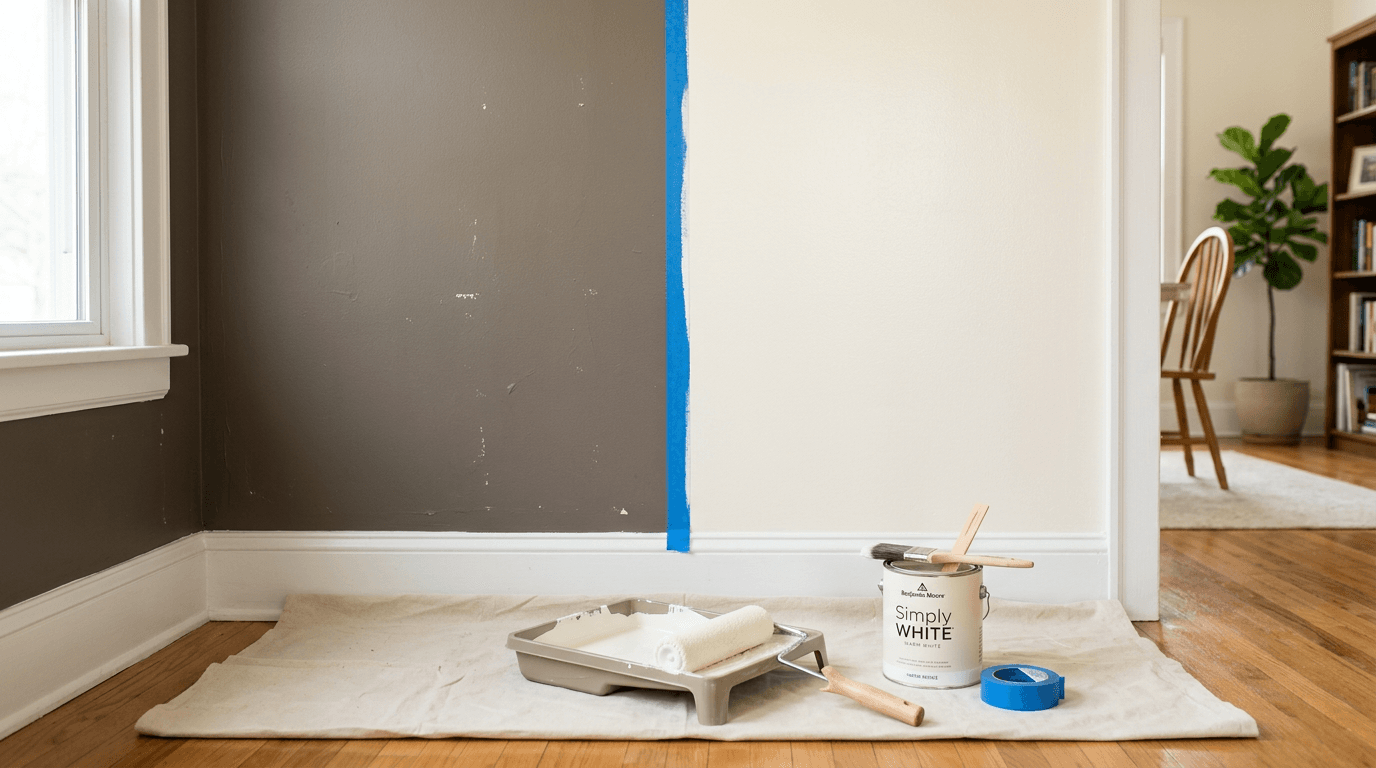
Fresh paint makes a space feel cared for. Faded, scuffed, or patchy paint does the opposite. The question is whether targeted touch-ups will fix your walls or whether a full repaint is the smarter investment. Get it wrong in either direction and you waste money — either paying for a full repaint you did not need, or doing touch-ups that look worse than the original damage because they will not blend. Quick answer: touch-ups work when paint is under five years old, damage is isolated, and you have matching paint on hand. If you cannot hit all three of those conditions, a full repaint is usually more cost-effective.
Here is a practical breakdown of how to decide.
When Touch-Ups Actually Work
Touch-ups are the right call when:
- The paint is relatively fresh — ideally under three to five years old. Newer paint has not had time to fade significantly from sun exposure, and the sheen is still close to what came out of the can.
- Damage is isolated and small. Single nail holes from picture-hanging, a scuff mark from a moved piece of furniture, a spot where painter's tape pulled up the finish — these are genuinely touch-up situations.
- You have the original paint. If it has been stored sealed and stirred thoroughly, leftover paint from the same batch is your best shot at a match. Even then, test it on an inconspicuous area first — paint in the can looks different wet than dry, and the wall color has shifted with age.
- The damage is not in a high-contrast or high-visibility spot. A scuff behind the couch is not the same problem as a scuff at eye level in a hallway where every visitor walks past it.
For hallways and stairwells in Rockland County homes — places that take constant abuse from backpacks, coat sleeves, and furniture — fresh-enough paint and isolated damage are the conditions where touch-ups genuinely earn their keep. See our page on small repairs homeowners put off too long for how paint damage fits into a broader maintenance picture.
The Blending Challenge: Why Touch-Ups Can Look Worse
This is the honest part of the conversation that does not always get said: even with the exact same paint, a touch-up can look noticeably different from the surrounding wall. Several factors work against you:
- Fading. Sunlight bleaches paint over time. The wall has been fading for years; the touch-up is fresh. Even with the same formulation, the colors will not match.
- Sheen shift. Paint sheens change slightly as they age — a flat becomes more matte, a satin loses some gloss. A fresh touch-up in a flat paint can have more sheen than the surrounding wall.
- Application method. If the original wall was rolled, a brush touch-up will show the difference in texture. Use a small roller — a four-inch foam roller — rather than a brush for anything larger than a pin hole.
- Coat count. A single-coat touch-up over a porous spackle patch will look thinner than the surrounding wall. Prime the patch first, let it dry fully, then apply at least two thin coats.
To minimize blending problems: use the same application tool as the original, feather the edges of the patch into the surrounding area rather than painting a hard-edged circle, and consider painting the full wall from corner to corner rather than just the damaged section if the paint is more than a few years old. A corner-to-corner single wall is often the right compromise between a touch-up and a full room repaint.
When a Full Repaint Is the Better Investment
A full repaint — walls, ceiling, and trim — is the right call in these situations:
- Paint is more than seven to ten years old and visibly faded. Any touch-up will read as a bright spot on an aged wall. You will see the difference, and so will guests.
- Scuffs and patches cover most of a wall or multiple walls. At some point the math inverts: you spend 60% of what a full repaint costs to fix 40% of the walls, and the room still looks uneven.
- You are changing colors entirely. This is not a touch-up situation at all.
- The existing sheen is wrong for the room. Semi-gloss in a living room shows every imperfection in the wall; a repaint in a flat or eggshell finish fixes the problem touch-ups cannot.
- You are updating the room. New light fixtures, updated hardware, or a custom accent wall all look better with fresh paint on the surrounding surfaces. A room refresh is a system — see cabinet hardware upgrades and when to replace vs. repair a light fixture for how these elements work together.
- You are preparing to sell. Buyers and their agents notice paint. Fresh, neutral paint is one of the highest-return pre-sale investments. See common handyman jobs before selling a home for the full pre-sale picture.
Touch-Up vs. Full Repaint: Decision Table
| Situation | Best Choice |
|---|---|
| 1–3 nail holes, paint under 3 years old, original paint on hand | Touch-up |
| Scuff marks in hallway, paint under 4 years old | Touch-up (use small roller, feather edges) |
| Paint over 7–10 years old, any visible damage | Full repaint |
| Damage covers more than half a wall | Full repaint (corner to corner at minimum) |
| Changing paint color | Full repaint |
| Pre-sale preparation | Full repaint |
| Wrong sheen for the room | Full repaint |
| One wall needs work, paint under 5 years old, perfect color match | Single-wall repaint |
Proper Prep: Where the Result Is Actually Won or Lost
Whether you are touching up or doing a full repaint, prep work determines whether the result looks professional or amateur.
For touch-ups: 1. Fill holes with lightweight spackle and let it dry completely — do not rush this 2. Sand the dried patch smooth and feather the edges so there is no ridge 3. Prime the patch (even a quick spot prime with a foam brush makes a meaningful difference in how the final coat looks) 4. Apply two thin coats of matched paint with a small roller, feathering into the surrounding area
For full repaints: 1. Fill all holes, dings, and cracks; sand smooth 2. Wash walls with a damp cloth to remove dust, cobwebs, and grease — especially in kitchens and areas near heat registers 3. Remove or tape off switch plates, outlet covers, and hardware 4. Apply painter's tape to trim, ceiling, and where walls meet different surfaces 5. Cut in at all edges before rolling — the cut-in lines along the ceiling and trim separate a professional result from a DIY one 6. Roll in a W or M pattern to minimize lap marks, working in sections
For drywall repairs that precede painting — the most common situation — the patch must be fully cured, sanded, and primed before paint goes on. A patch painted over without primer will show through almost every time, especially in raking light. See how to know when drywall needs professional repair if you are assessing damage before deciding on paint approach.
Typical 2026 Painting Prices in Rockland County
These are general estimates for reference, not a quote. Actual cost depends on room size, ceiling height, number of coats, trim complexity, and prep time. For a real number, request a free estimate. See our full Rockland County handyman pricing guide for more context.
| Job | Typical 2026 Range |
|---|---|
| Touch-up visit (1–2 walls, matching paint provided) | $95–$175 |
| Single wall repaint (corner to corner, one color) | $175–$325 |
| Bedroom repaint (walls only, 10x12, 2 coats) | $475–$675 |
| Bedroom repaint (walls + ceiling + trim) | $725–$1,050 |
| Living/dining room (walls + trim, 15x20) | $1,050–$1,650 |
| Accent wall only (one wall, prep + 2 coats) | $250–$400 |
| Hallway repaint (walls, standard length) | $350–$575 |
These figures are general estimates for typical Rockland County conditions, not a quote. High ceilings, dark-over-light color changes, and trim complexity affect price significantly.
Frequently Asked Questions
Can a paint store perfectly match my existing wall color?
Almost never, and the older the paint, the wider the gap. Paint stores scan a chip from the wall and formulate a close match, but the existing wall has been fading from sunlight for years. The match from the store is what the color looked like new. For isolated touch-ups in a low-visibility spot, store-matched paint is often good enough. For anything visible, expect a slight difference and plan to paint at least the whole wall.
How do I keep leftover paint usable for future touch-ups?
Store it sealed in its original can or an airtight container, label it with the room and date, and keep it in a temperature-stable space — not the garage in Rockland County, where winter temperatures ruin latex paint. A properly stored gallon will remain usable for two to three years. Press plastic wrap against the paint surface before sealing to reduce oxidation.
Should I use flat or eggshell paint for interior walls?
Eggshell is the practical choice for most rooms — it has a slight sheen that makes it more washable than flat without showing imperfections the way satin or semi-gloss does. Flat paint hides wall texture better and is sometimes preferred in living rooms and bedrooms where washability is less of a concern. Avoid semi-gloss on walls unless you specifically want that look; it highlights every bump and flaw.
Does painting over a patch always look different?
It does if the patch is not primed first. An unprimed spackle patch is more absorbent than the surrounding wall, so paint soaks in unevenly and the patch shows through — this is called flashing. Spot-priming the patch before painting solves the problem in most cases. For larger or water-damaged areas, a full coat of primer over the repaired section is the right approach.
How long does a room repaint take?
A standard 10x12 bedroom with walls only typically takes one professional 5–7 hours. Add ceiling and trim and you are looking at 8–12 hours — often a full day or spread across two shorter visits. Living rooms, hallways with high ceilings, and rooms with extensive trim take longer. Prep — not painting — is usually the majority of the time on a quality job.
Is painting something a handyman does, or should I hire a painter?
Either can produce excellent results. We handle painting throughout Rockland County as part of broader projects — often combining it with drywall repair, door installation, or room refreshes. For whole-house painting, a dedicated painting contractor may be more efficient. For single rooms, accent walls, or painting combined with other work, a skilled handyman is a practical and cost-effective option.
Ready for Walls That Look Right?
Whether you need a few touch-ups done properly or a full room repaint, we handle both throughout Rockland County — New City, Nyack, Pearl River, Nanuet, Suffern, and everywhere in between. Call or text (908) 461-2688 or request a free estimate and we will tell you honestly which approach makes sense for your walls.
Odds & Ends Handyman Service is a licensed Rockland County Home Improvement Contractor (#H-25-600), insured for $1,000,000, and in business since 2001 — serving the Town of Tuxedo, including Tuxedo Park, and all of Rockland County, NY.