
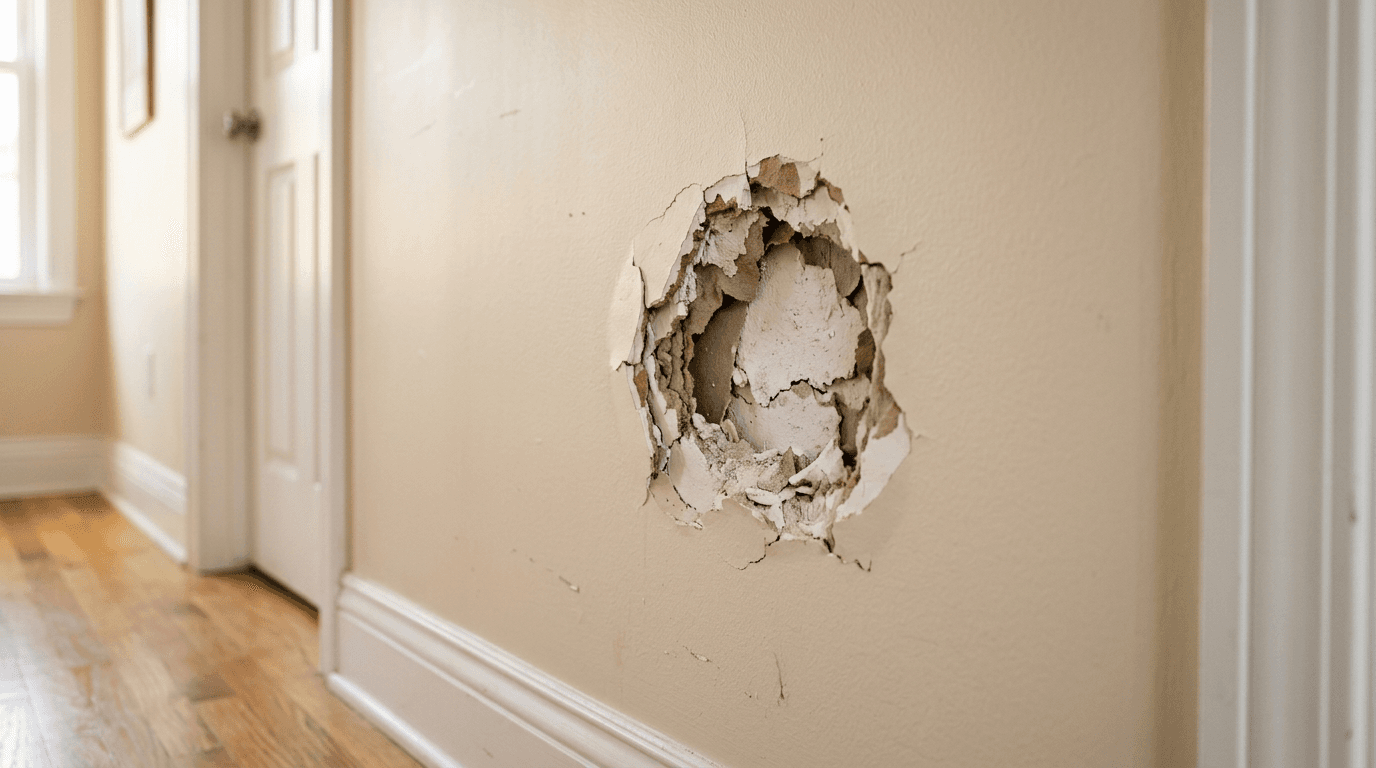
Drywall damage has a way of nagging at you — a doorknob-shaped hole behind a door, a hairline crack creeping out from a window corner, a soft brown stain spreading across a ceiling. The question is always the same: can I just fix this myself, or do I need to call someone?
Short answer: small nail holes, dings, and hairline scuffs are genuine DIY jobs — spackle, sand, paint, done. But once drywall damage involves water, recurring cracks, holes bigger than your fist, sagging, or anything in a high-visibility room, it takes a professional to make the repair actually disappear. Below are the exact warning signs, how repair-versus-replacement is decided, and what drywall repair costs in Rockland County in 2026.
Can You Repair Drywall Yourself?
Plenty of drywall damage is fair game for a confident homeowner. You can usually DIY:
- Nail and screw holes from hanging pictures
- Small dents and surface scuffs
- Minor dings under about an inch across
- Anchor holes left behind after removing shelves or curtain rods
The toolkit is cheap and the stakes are low: lightweight spackle, a putty knife, fine sandpaper, primer, and matching paint. If the result is slightly imperfect in a closet or garage, no one will ever notice.
The trouble starts when people apply that same spackle-and-go approach to damage that needs structural backing, texture matching, or moisture remediation — that is how a patch you can see for years gets created. Our DIY-or-hire-a-handyman guide covers the full decision, but for drywall specifically, here are the signs to watch.
6 Signs Your Drywall Needs Professional Repair
1. Cracks that keep coming back
If you have patched a crack and it reappeared within a few months, the crack is a symptom, not the problem. Something underneath is moving — foundation settling, seasonal framing movement, a moisture cycle, or improper original installation. A professional traces the crack to its cause and repairs it so it stays gone, rather than spackling over it for the third time.
2. Water stains, bubbling, or soft spots
Discoloration, bubbling paint, or drywall that feels soft and spongy means water has been there. Water-damaged drywall loses strength and can hide mold inside the wall cavity. The fix is not a skim coat — the affected section has to be cut out, the moisture source confirmed dry, and new board installed. This is common in older Rockland County homes where a slow plumbing leak goes unnoticed for years.
3. Holes bigger than your fist
A fist- or doorknob-sized hole cannot just be filled — there is nothing behind it to fill against. A proper repair needs backing material, mesh or paper tape, and several coats of joint compound, each one feathered wider and sanded smooth so the patch blends into the surrounding wall. Getting that seamless is the difference between a repair and a visible scar.
4. Sagging or bulging sections
Drywall that bows away from the studs has either lost its fasteners or absorbed moisture. You cannot push it back and paint over it — the section needs to be re-secured to solid framing or replaced outright.
5. Cracked or peeling seam tape
When the paper tape over a drywall seam starts to bubble, peel, or crack in a straight line, the joint underneath has failed. Re-taping and re-mudding a seam invisibly — especially in a hallway or living room where light rakes across it — is a skill, not a quick patch.
6. Damage in a high-visibility room
This is the honest one. The same small patch is a DIY job in a laundry room and a pro job in your front entry. If the repair sits where guests, buyers, or you will look at it every day, the bar is "looks like it never happened" — and matching texture and paint sheen to a wall that has aged ten years is genuinely hard. If you are prepping to sell, see our pre-sale handyman checklist.
Drywall Repair vs. Replacement: How to Decide
Homeowners often ask whether a wall should be patched or torn out. The industry rule of thumb: when repairing would cost more than roughly 40–50% of replacing the section, replace it. In practice:
- Repair — isolated holes, cracks, dents, and small water spots on otherwise sound drywall.
- Replace the section — board that is soft, crumbling, moldy, widely water-damaged, or sagging across a large area.
A few small holes almost always get patched. A ceiling with a three-foot water stain almost always gets a new section. Most jobs are obvious once the damage is opened up — and a good handyman will tell you honestly which one you are looking at.
How Much Does Drywall Repair Cost in Rockland County?
These are typical 2026 ranges from real Odds & Ends jobs across Rockland County. Full methodology is in our 2026 Rockland County handyman pricing guide.
| Drywall job | Typical 2026 price | Time on-site |
|---|---|---|
| Small holes (under 4 in), 1–3 spots | $150–$220 | 1.0–1.5 hr |
| Mid-size hole (doorknob, 4–10 in) | $220–$340 | 1.5–2.5 hr |
| Large patch (10–24 in, backing + mesh) | $340–$525 | 2.5–4.0 hr |
| Water-damaged section (cut and replace) | $475–$725 | 4.0–6.0 hr |
| Texture matching (orange peel, knockdown) | add $50–$150 | add 0.5 hr |
| Repaint after patch (one wall, one coat) | add $120–$180 | add 1.0 hr |
The biggest cost drivers are water damage (always more involved than dry damage), texture matching, and getting a paint match on a wall that has been up for a decade. When a patch is in a visible spot, repainting the full wall at the same visit is usually money well spent — see paint touch-ups vs. repainting a room.
Why Older Rockland County Homes Need Extra Care
Many homes in Nyack, Piermont, Tappan, and the older sections of New City were built with plaster and lath, not drywall. Plaster cracks differently, is more brittle, and a standard drywall-patch approach can make it worse. Repairing plaster — or blending a drywall patch seamlessly into a plaster wall — is a different skill. If your home predates 1960, mention it when you request an estimate so the repair is approached the right way.
Frequently Asked Questions
Can I repair drywall myself?
Yes, for small, low-stakes damage — nail holes, dents, and minor scuffs — using spackle, a putty knife, sandpaper, and matching paint. DIY repair runs into trouble with holes larger than a few inches, water damage, recurring cracks, sagging, and any repair in a high-visibility room, where texture and paint matching make the difference between an invisible fix and a patch you see for years.
When should drywall be replaced instead of repaired?
Replace drywall when the board is soft, crumbling, moldy, widely water-damaged, or sagging across a large area. A common guideline is to replace rather than repair when the repair would cost more than about 40–50% of replacement. Isolated holes, cracks, and small water spots on otherwise sound drywall should simply be patched.
How much does it cost to fix a hole in the wall?
In Rockland County in 2026, patching one to three small holes typically runs $150–$220, a doorknob-sized hole $220–$340, and a large patch needing backing and mesh tape $340–$525. Water-damaged sections that must be cut out and replaced run $475–$725. Texture matching and repainting the wall are common add-ons.
Why does my drywall crack keep coming back?
A recurring crack means something underneath is moving — foundation settling, seasonal framing movement, a moisture cycle, or a poorly finished original seam. Spackling the surface again will not hold. A professional repair addresses the underlying cause and reinforces the joint so the crack does not return.
Do handymen do drywall repair?
Yes — drywall repair is core handyman work, including holes, cracks, water-damaged sections, seam repair, and texture matching, and it does not require a specialty license. See everything we handle on our drywall repair service page and the full list of handyman jobs.
Get an Honest Assessment of Your Drywall
Not sure whether your damage is a DIY afternoon or a job for a pro? Snap a photo and request a free estimate, or call or text (908) 461-2688. We will tell you honestly which one it is — and if it is genuinely a DIY job, we will say so. Odds & Ends has repaired drywall and plaster across Rockland County since 2001.
Odds & Ends Handyman Service is a licensed Rockland County Home Improvement Contractor (#H-25-600), insured for $1,000,000, and in business since 2001 — serving the Town of Tuxedo, including Tuxedo Park, and all of Rockland County, NY.