
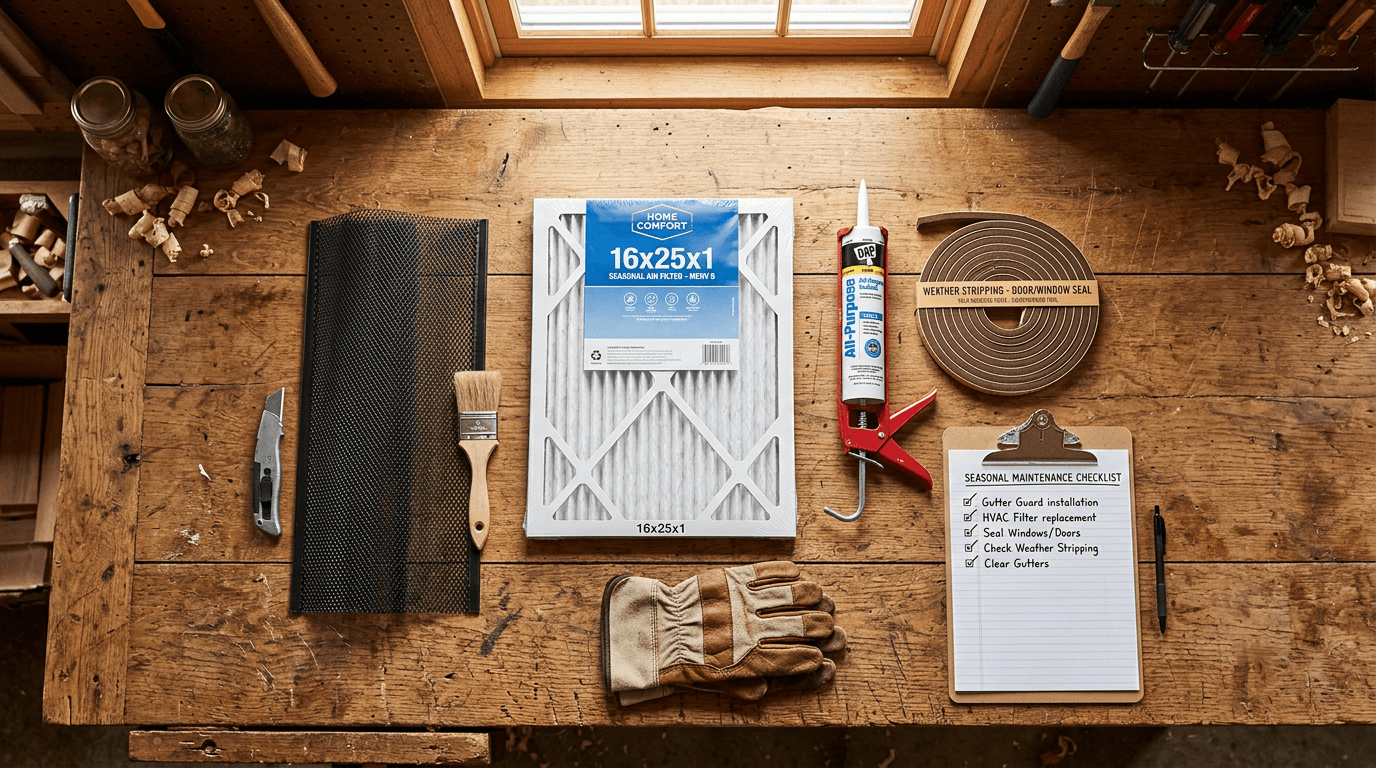
Rockland County runs through all four seasons with conviction. Winters bring hard freezes and occasional ice storms. Spring arrives fast with heavy rain. Summers are hot and humid enough to warp wood and grow mold. Fall is short but critical — the window between leaf-drop and first freeze is when you either prepare or pay for it in February.
Quick answer: Staying ahead of seasonal maintenance in Rockland County means completing four focused rounds of work each year: a spring damage assessment and deck/gutter check, a summer ventilation and exterior maintenance pass, a fall weatherproofing and gutter clean, and a winter interior safety review. This checklist covers all four.
We offer seasonal maintenance visits throughout Rockland County. But whether you call us or do it yourself, use this list.
Why Seasonal Maintenance Matters More in Rockland County
Rockland County has a specific combination of factors that makes routine maintenance genuinely important — not just a nice-to-have.
Older housing stock. The river villages — Nyack, Piermont, Tappan, Sparkill — have significant numbers of pre-war homes with plaster walls, original wood windows, and aging exterior trim. These materials require more frequent attention than modern construction.
Hudson River humidity. Homes within a mile of the river deal with higher ambient moisture year-round. Wood decks, exterior trim, and caulking joints deteriorate faster than the same materials inland.
Steep lots. Many Rockland County homes — particularly in Nyack and along the Route 9W ridge — sit on sloped lots where water drainage matters enormously. A blocked downspout extension or a graded-away-from-house problem causes foundation water intrusion.
Freeze-thaw cycles. Rockland winters are not consistently cold enough to stay frozen. The repeated freeze-thaw cycle is harder on exterior caulking, masonry, and decks than a single hard winter. A crack that is fine in November may be an inch wide by March.
Small repairs ignored across one season become expensive fixes by the next. The small repairs homeowners put off too long post covers the most common examples.
Spring Checklist: Assess Winter Damage and Open the Season
Spring is your diagnostic window. Walk the exterior of the house before you do anything else.
Exterior Structure and Trim
- Inspect siding and trim for boards that have cracked, pulled away, or show signs of rot at the base. Pay special attention to trim at ground level and around window sills, where water tends to pool.
- Check exterior caulking around all windows, doors, and where trim meets siding. Winter contraction opens gaps that need to be resealed before spring rains drive water into the wall cavity.
- Inspect the roof edge and fascia from the ground with binoculars. Fascia that has darkened or softened is losing its paint protection and will rot quickly without attention.
Gutters and Drainage
- Clean gutters of the debris that accumulated through winter and late fall. Check that downspouts are clear and that extensions are directing water at least four feet away from the foundation.
- Check downspout connections — the joints between the vertical downspout and the elbow at the bottom often separate over winter.
Decks and Porches
- Walk the entire deck and press on boards with your foot. Any board that flexes more than the others or feels soft underfoot needs closer inspection. See deck repair warning signs for a full checklist.
- Grab each railing post and push laterally. Any movement is a problem. Posts loosen at their base connections over winter when moisture causes the wood and hardware to cycle.
- Inspect ledger board flashing where the deck attaches to the house — this is where water intrusion most commonly occurs.
Our deck repair service and fence repair service both see peak demand in spring for good reason.
Safety Systems
- Test smoke and CO detectors and replace batteries. Spring is a natural reset point.
- Check window screens for tears and refit screens that have been stored for winter.
- Test exterior hose bibs by connecting a hose — a spigot that was frozen over winter may leak at the stem seal rather than at the outside end.
Summer Checklist: Comfort, Ventilation, and Exterior Maintenance
Summer maintenance is less about damage and more about comfort, ventilation, and catching exterior wear before the fall season.
Comfort and Ventilation
- Ceiling fans should run counterclockwise (when viewed from below) in summer, pushing air straight down to create a cooling effect. Most fans have a small direction switch on the motor housing. We handle ceiling fan installation and replacement if yours needs upgrading or if you want to add fans in rooms that lack them.
- Bathroom exhaust fan vents accumulate lint and debris. Remove the cover, vacuum the fan blades, and check that the vent pipe is actually exhausting to the outside rather than into the attic — a common installation shortcut that causes moisture damage.
- Check attic ventilation if accessible. Blocked soffit vents or a malfunctioning ridge vent make summers significantly hotter and increase cooling costs.
Exterior Paint and Caulking
- Touch up exterior paint before UV exposure worsens any peeling or flaking sections. Once paint starts peeling, the underlying wood is exposed; the repair scope grows quickly. Our painting service handles both touch-ups and full exterior sections.
- Re-caulk bathroom tubs, showers, and sink surrounds if the existing caulk is cracking, pulling away from the tile, or showing discoloration. Failed caulk is one of the most common causes of water damage behind tile. See common bathroom fixes a handyman can handle.
- Check exterior light fixtures and motion sensors. Insects nest in outdoor fixtures over the spring and summer; clean the lenses and check that bulbs are working. See light fixture installation.
Deck and Fence
- Repair any deck boards identified in spring before the outdoor entertaining season begins. A soft board only gets softer through summer.
- Check fence posts for wobble — post bases heave and shift through winter and may need re-setting or at minimum re-securing by summer. Our fence repair vs. replacement guide helps you decide which approach makes sense.
Fall Checklist: The Most Critical Season
Fall is the highest-stakes maintenance window. What you do in October and early November determines how your house comes through winter.
Gutters (Again — This One Is Critical)
- Clean gutters after leaves have fully dropped — not before. In Rockland County, that typically means late October through mid-November depending on the tree species around your home. Gutters full of wet leaves cause ice dams at the roof edge, which force water under shingles and into the ceiling.
- Verify downspout extensions are in place and clear before the first freeze.
Weatherproofing
- Seal all exterior caulking gaps around windows, doors, and penetrations (pipes, wires, HVAC lines entering the house). Use a siliconized acrylic caulk rated for exterior use — pure silicone does not paint well; latex alone does not hold up.
- Install or replace weatherstripping on exterior doors. A door with worn weatherstripping is a continuous source of heat loss and drafts. Replacement weatherstripping is inexpensive; the installation is straightforward. See doorknob and handle replacement if the hardware itself needs attention at the same time.
- Check and replace the furnace filter before the heating season begins. A clogged filter makes the system work harder and reduces air quality. This is also the time to test the thermostat — or to install a smart thermostat if you have been considering it. See smart home device setup.
Exterior Water and Storage
- Drain and disconnect garden hoses from all exterior bibs. A hose left connected traps water in the pipe inside the wall and causes the pipe to freeze even if the bib has a frost-free design.
- Shut off and drain any irrigation systems if applicable.
- Move outdoor furniture to a protected location or cover it properly — Rockland County winters are wet enough that uncovered wood furniture deteriorates noticeably in a single season.
Siding and Trim Repairs
- Repair any loose siding or trim before cold sets in. Water behind siding in winter causes damage that multiplies — the freeze-thaw cycle turns a small gap into a split board by spring.
Winter Checklist: Indoor Safety and Monitoring
Winter maintenance is primarily about safety and monitoring rather than exterior work.
Safety Systems
- Test smoke and CO detectors again. Heating-season risk is genuinely higher: furnaces, fireplaces, and space heaters are all active. The smoke detector testing guide covers what to check and when to replace.
- Check that dryer vents are clear. Lint buildup in dryer vents is a fire hazard that worsens when the dryer runs more frequently in winter. Disconnect and clean the vent run if you have not done so in the past year.
Cold Weather Monitoring
- Check for drafts around windows and doors by holding your hand near the frame on a cold day. A lit incense stick moved slowly around the perimeter will show air movement. Add weatherstripping or apply rope caulk (removable in spring) to problem areas.
- Monitor humidity indoors. Winter air is dry, and forced-air heating makes it drier. Very dry indoor air causes wood floors and trim to shrink and gap. A whole-house humidifier or room humidifiers can prevent cracking in older homes with original hardwood.
- Inspect plumbing in unheated spaces — basement corners, garage walls, crawl spaces — during the first hard freeze. Pipes in exterior walls of older homes are at risk. Open cabinet doors under kitchen sinks on exterior walls on nights below 15 degrees.
- Check interior doors — swelling in very cold, damp weather can cause interior doors to stick or fail to latch. Adjusting a door in winter avoids planing a door that will return to normal clearance in spring.
Seasonal Maintenance at a Glance
| Task | Spring | Summer | Fall | Winter |
|---|---|---|---|---|
| Clean gutters | Yes | No | Yes (critical) | No |
| Inspect/repair deck | Yes | Yes | No | No |
| Check/replace caulking | Yes | Yes (baths) | Yes (exterior) | No |
| Test smoke/CO detectors | Yes | No | No | Yes |
| Ceiling fan direction | No | Counterclockwise | Clockwise | No |
| Replace furnace filter | No | No | Yes | Midseason |
| Weatherstripping check | No | No | Yes | Monitor |
| Check exterior paint/trim | Yes | Yes | Yes | No |
| Drain exterior water | No | No | Yes | Monitor |
Frequently Asked Questions
When should I clean gutters in Rockland County? Twice a year is standard: once in late spring after any remaining seed pods and debris have settled, and once in late fall after the leaves have fully dropped. The fall cleaning is the more critical one for preventing ice dams. In Rockland County, late-fall cleaning typically means late October to mid-November.
How do I know if my deck needs repair before spring entertaining season? Walk the deck and press firmly on each board. Soft or spongy boards need replacement. Push each railing post side-to-side — any movement means the connection needs attention. Check the deck surface for boards that have cupped significantly or developed wide cracks. Our deck repair warning signs post has a full checklist.
What does ice dam damage look like inside the house? Water stains on the ceiling, particularly near exterior walls and in corners. Peeling paint on interior walls near the roofline. In bad cases, water running down the wall or dripping from light fixtures. Ice dams are caused by heat escaping through the roof melting snow, which refreezes at the cold eave and backs up under shingles. Keeping gutters clear in fall significantly reduces the risk.
Can a handyman handle all of this seasonal work, or do I need multiple contractors? Most seasonal maintenance tasks fall squarely in handyman territory: caulking, weatherstripping, minor deck repairs, fixture replacements, detector swaps, door adjustments, and gutter cleaning. Work requiring a licensed plumber (pipe repairs) or electrician (new circuits, panel work) is different — we will tell you clearly which category a task falls into. See what a handyman can legally do in New York for more detail.
Do you offer seasonal maintenance visits on a scheduled basis? Yes. We can schedule a seasonal walkthrough and task list for spring and fall — the two busiest maintenance windows. Call or text to discuss what that looks like for your home.
Schedule Your Seasonal Maintenance Visit
Do not wait until something fails to deal with it. A seasonal visit from Odds & Ends covers the items on this list efficiently, with honest assessments and no upselling. Call or text (908) 461-2688 or request a free estimate online. We serve all of Rockland County — New City, Nyack, Pearl River, Nanuet, Suffern, Haverstraw, Piermont, and every community in between.
Odds & Ends Handyman Service is a licensed Rockland County Home Improvement Contractor (#H-25-600), insured for $1,000,000, and in business since 2001 — serving the Town of Tuxedo, including Tuxedo Park, and all of Rockland County, NY.
Related