
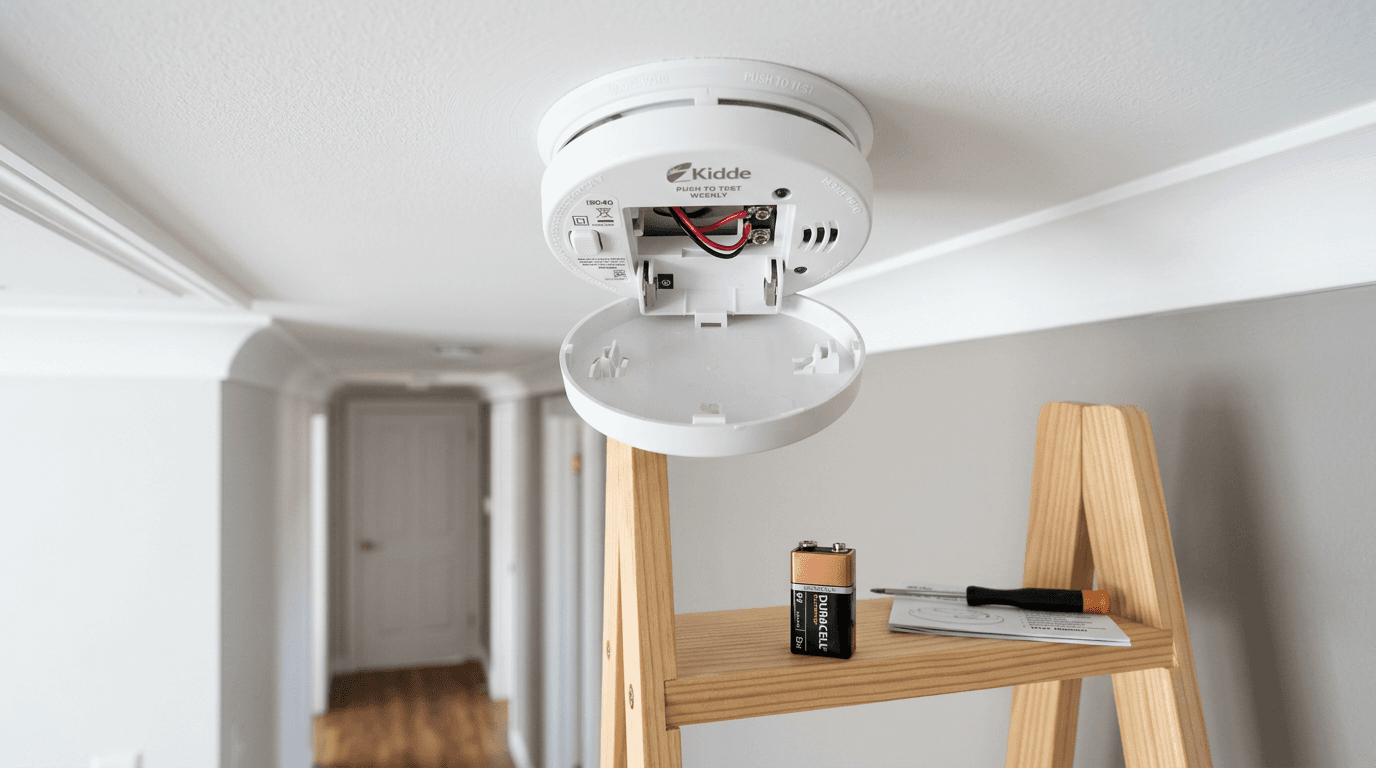
Most homeowners know they should test their smoke detectors. Far fewer actually do it — and even fewer know that an untested detector sitting on the ceiling for fifteen years provides essentially no protection at all. Smoke detector components degrade over time. A unit that tested fine three years ago may fail silently, with no indication to anyone in the house.
Short answer: Test every smoke detector monthly. Replace batteries at least once a year. Replace entire units every 8–10 years. Make sure every bedroom, every sleeping area hallway, and every level of your home — including the basement — has coverage. In Rockland County homes from the 1980s and 1990s, many original detectors are still in place and should have been replaced years ago.
Why This Matters More Than Most Homeowners Realize
The National Fire Protection Association reports that three of five home fire deaths occur in homes with no smoke alarms or with smoke alarms that did not work. That statistic isn't about fires that overwhelmed working alarm systems — it's about entirely preventable deaths in homes where the alarm was dead, missing, or had been removed.
The most common reasons detectors fail silently:
- Dead battery — The unit chirped for a few days, no one replaced the battery, and eventually the chirping stopped. The detector is now offline.
- Unit removed and never replaced — Someone tired of nuisance alarms from cooking pulled the detector off the ceiling and forgot to put it back.
- Age-related sensor failure — Ionization sensors degrade. A unit more than 10 years old may pass a button test (which only tests the electronics, not the sensor) but fail to detect actual smoke in time.
- Painted over — In older homes throughout Nyack, Piermont, and Tappan, we regularly find detectors with one or more coats of paint over the sensor openings. A painted detector is not a functioning detector.
How Often to Test — and What the Test Actually Tells You
Monthly Testing
Press and hold the test button until the alarm sounds — this should take no more than a few seconds. If the alarm sounds weak, replace the battery immediately. If it doesn't sound at all after a fresh battery, replace the unit.
One important limitation: the test button tests the alarm circuit and the horn. It does not test whether the smoke sensor itself can detect actual smoke. Units more than 8–10 years old that pass the button test should still be replaced on schedule.
Annual Minimum: Change of Clocks
At minimum, test every detector when you change clocks in spring and fall. Replace all batteries at fall clock change as a standard practice — even if they haven't chirped yet. Battery-powered detectors are only as good as their power source.
New York State Law Requirements
New York State requires smoke alarms in every bedroom, outside each sleeping area, and on every level of a dwelling. For replacement alarms in existing homes, NY now requires sealed 10-year battery units (eliminating the need for annual battery changes on new installs). Carbon monoxide alarms are also legally required in any home with a fuel-burning appliance, attached garage, or fireplace. We always recommend confirming current requirements with your local building department, as rules update periodically.
When to Replace the Entire Unit
The 8–10 Year Rule
Smoke detectors have a defined service life. The manufacture date is printed on a label on the back of the unit — pull the detector off the ceiling and look. If there's no date visible, or if the date shows the unit is 10 or more years old, replace it. Many homes in Clarkstown, Ramapo, and Orangetown that were built or last renovated in the late 1980s and 1990s still have their original detectors in place.
A unit installed in 1998 is now nearly 30 years old. It should have been replaced at least twice.
Visible Damage or Paint
Any detector with cracked housing, paint over the sensor grille, or visible insect intrusion should be replaced immediately regardless of age.
Repeated False Alarms From Same Unit
A detector that nuisance-alarms repeatedly (not from cooking, but randomly) may have a contaminated sensor. Replace it rather than removing it.
Placement: Where Detectors Need to Be
| Location | Required? | Notes |
|---|---|---|
| Inside every bedroom | Yes | Including guest rooms |
| Outside each sleeping area (hallway) | Yes | Should wake sleeping occupants |
| Every level including basement | Yes | Even unfinished basements |
| Top of stairways | Strongly recommended | Heat and smoke rise |
| Kitchen | Yes, with caution | Use photoelectric type; position 10+ feet from stove |
| Attached garage | CO detector required | Smoke detector also recommended |
| Near furnace / water heater | CO detector required | Any fuel-burning appliance |
Photoelectric vs. Ionization
- Ionization detectors are more responsive to fast, flaming fires but prone to nuisance alarms from cooking.
- Photoelectric detectors are more responsive to slow, smoldering fires (the most common type in bedroom fires) and produce fewer cooking false alarms.
- Combination units with both technologies are increasingly common and provide the broadest protection.
For kitchens and areas near cooking, photoelectric significantly reduces the "disabled by frustration" problem where occupants remove detectors after too many false alarms.
Hardwired vs. Battery-Only Units
Many homes in Rockland County built after the early 1990s have hardwired interconnected smoke detectors — when one alarm sounds, they all sound. This is a meaningful safety advantage: a fire starting in the basement will trigger alarms on every floor simultaneously.
Key points on hardwired systems:
- Hardwired detectors still require backup batteries. If the power goes out during a fire, the battery takes over.
- When one unit in an interconnected system reaches end of life, replace all units in the system with the same brand and interconnect protocol if possible — mixed brands sometimes fail to interconnect reliably.
- Replacing a hardwired detector does not require an electrician if you're swapping the same wire harness connector. We handle this routinely.
For battery-only homes, the newer sealed 10-year lithium battery units (now required under NY law for replacements) eliminate the annual battery-change task and the risk of a dead battery going unnoticed.
Carbon Monoxide Detectors: The Invisible Threat
Carbon monoxide is colorless and odorless. By the time symptoms appear — headache, nausea, disorientation — occupants may already be unable to respond effectively. Any home with:
- A gas furnace, boiler, or water heater
- A gas range or oven
- An attached garage
- A fireplace (wood or gas)
- A generator
...needs CO detection on every level and outside sleeping areas. Many newer smoke detectors are combination smoke/CO units, which simplifies placement. We recommend them for most installations.
See our related post on seasonal home maintenance in Rockland County for the broader annual safety checklist.
What We Do During a Detector Service Visit
When a homeowner in New City, Upper Nyack, or Blauvelt calls us for a smoke detector checkup, here is what a typical visit includes:
- Test every detector in the home using the test button
- Check manufacture dates on all units — recommend replacement for any over 10 years
- Replace batteries in all battery-powered units (we bring standard 9V and AA cells)
- Inspect for paint over sensor grilles or damaged housings
- Verify placement coverage — identify any gaps (unprotected bedrooms, levels without coverage)
- Replace expired units on the spot if the homeowner has new units available, or advise on what to purchase
- Install any new units needed, including hardwired swaps
This typically takes under an hour for a single-family home. It's also a natural add-on when we're already at a home for other work — see air filter replacement as another quick maintenance task we handle on the same visit.
Frequently Asked Questions
How often should smoke detectors be replaced in Rockland County homes?
Every 8–10 years, per NFPA guidelines and manufacturer recommendations. The manufacture date is printed on the back of the unit. Many homes in Rockland County — particularly those built or last renovated in the 1980s and 1990s — still have original detectors that should have been replaced a decade ago.
Does New York State require sealed battery smoke detectors?
Yes. New York State law requires that replacement smoke alarms in existing dwellings use sealed, non-removable 10-year batteries. This applies when you're replacing an existing alarm, not just adding a new one to a home that already has one. Confirm specifics with your local building department for your municipality.
Can a handyman replace hardwired smoke detectors?
Yes. Replacing a hardwired smoke detector — disconnecting the existing wire harness connector and attaching a new unit with the same connector — is within handyman scope and does not require an electrician. Installing entirely new hardwired circuits for smoke detectors in a home that doesn't have them does require a licensed electrician.
Where exactly should smoke detectors be placed in a two-story home?
At minimum: inside every bedroom, in the hallway outside each sleeping area, on the main level, and in the basement. Ideally also at the top of the stairwell between floors. That's typically 6–8 detectors for a standard two-story home with 3 bedrooms. If you have a finished basement, add one there as well.
Why does my smoke detector keep going off near the kitchen?
Ionization-type detectors are sensitive to cooking steam and combustion byproducts from the stove. Replace the kitchen-area unit with a photoelectric detector and position it at least 10 feet from the stove. Never disable a detector — instead, fix the placement or replace with the right technology.
Can carbon monoxide and smoke detectors be combined?
Yes, and we typically recommend combination units for most rooms. They cover both hazards with one device, simplify placement, and are widely available from major manufacturers. Dedicated CO-only detectors are sometimes preferable near fuel-burning appliances in mechanical rooms.
Schedule a Smoke and CO Detector Check Today
This is one of the highest-return safety tasks a homeowner can do — and one of the quickest for us to handle. We serve all of Rockland County including Haverstraw, Thiells, Garnerville, Stony Point, and communities throughout Clarkstown and Orangetown. Call or text (908) 461-2688 or request a free estimate and we'll schedule a time that works.
Odds & Ends Handyman Service is a licensed Rockland County Home Improvement Contractor (#H-25-600), insured for $1,000,000, and in business since 2001 — serving the Town of Tuxedo, including Tuxedo Park, and all of Rockland County, NY.
Related