Smart home devices have become genuinely useful, not just novelties. A smart thermostat trims your heating bill. A video doorbell lets you see who's at the door from anywhere. A smart lock gives a contractor a temporary code without ever making a key. The technology has matured, and the prices have dropped to the point where most homeowners in Rockland County can justify at least a few upgrades.
The catch: many homes in our area were built in the 1950s through 1970s, and some river-village properties in Nyack, Piermont, and Tappan go back even further. Older wiring, aluminum conduit, two-wire circuits without a neutral, and plaster-and-lath walls all add friction to what looks simple on a YouTube tutorial. Short answer: smart home upgrades are absolutely worth doing — but a professional installation saves you the frustration of discovering your wiring doesn't match the instructions.
Start With the Highest-Impact Devices
Not every smart gadget earns its place. These four deliver the clearest return for Rockland County homeowners:
- Smart thermostat — Learns your schedule, adjusts when you leave, and can be controlled from your phone. Nest and Ecobee are the two most popular choices. Both typically reduce heating and cooling costs noticeably over a full year. The Ecobee includes a remote room sensor, which helps in older colonials and split-levels where temperature varies significantly between floors.
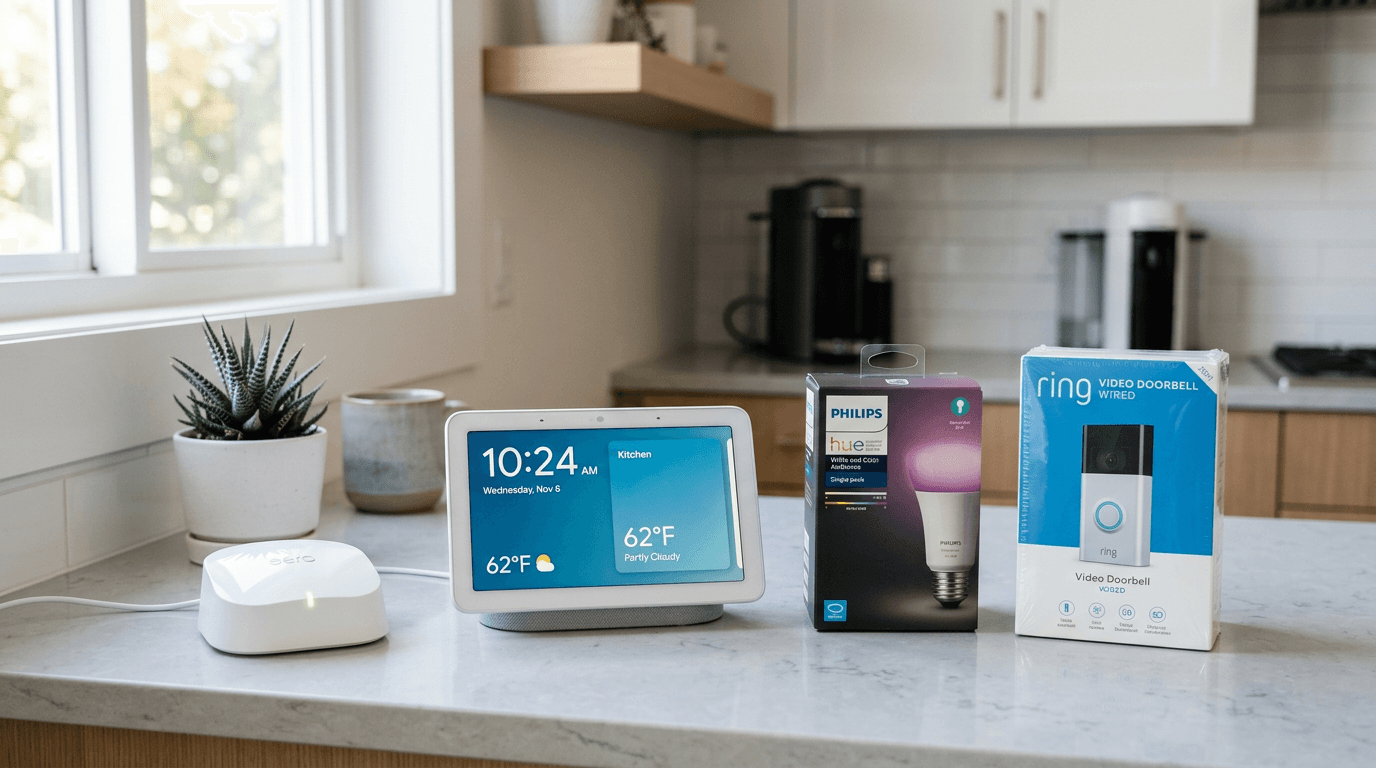
- Video doorbell — Ring and Google Nest Doorbell are the market leaders. You see live video, get motion alerts, and can talk to anyone at the door from your phone. In areas like New City, Pearl River, and Suffern, where package theft has become more common, a video doorbell is a practical deterrent.
- Smart lock — Replaces your existing deadbolt (or installs on the interior side of it). You can issue temporary codes for housekeepers, contractors, or guests, lock and unlock remotely, and see a log of who entered. Most models install in the same footprint as a standard deadbolt.
- Smart lighting controls — More useful than smart bulbs because wall switches still work normally for anyone in the house.
Smart Thermostats: The C-Wire Problem
Most modern smart thermostats need a continuous 24V power supply — delivered through a wire called the C-wire (common wire). Homes built after roughly 1990 usually have one. Older systems often don't.
If your thermostat has only two or three wires at the wall plate, you have a few options:
- C-wire adapter — Nest, Ecobee, and others sell adapters that use a spare wire in the existing bundle. This works in many cases.
- Power-stealing thermostats — Some models (older Nest versions) draw power directly from the heating/cooling circuit. They work intermittently in some systems and poorly in others with very efficient HVAC equipment.
- Run a new wire — The cleanest solution when the furnace and thermostat are accessible.
We sort this out before installing, so you don't end up with a thermostat that loses WiFi every few days.
Video Doorbells: Wired vs. Battery
Wired models (Ring Video Doorbell Pro, Nest Doorbell wired) connect to your existing doorbell wiring. Before installing, we check the transformer voltage — most need 16–24V AC. Older homes sometimes have underpowered transformers that need replacement. Wired models stay charged indefinitely and offer better video quality.
Battery models are simpler to install and work where there's no existing wiring, but they need recharging every few months depending on traffic. For a side or back door with occasional use, a battery model is perfectly practical.
Either way, the physical mounting, wire connection, and app configuration take about an hour when everything goes smoothly — longer in homes with plaster walls, where fishing wire requires more care.
Smart Locks: What to Know Before You Buy
Smart locks are among the most straightforward installations we do. The main considerations:
- Deadbolt compatibility — Most smart locks replace a standard single-cylinder deadbolt. Check your door's backset (typically 2-3/8" or 2-3/4") before ordering.
- Door prep — If the lock feels stiff or the door doesn't latch cleanly, fix the door first. A smart lock on a sticky door will frustrate you constantly.
- Connectivity — Wi-Fi locks connect directly to your network. Z-Wave and Zigbee locks need a compatible hub (SmartThings, Hubitat). Bluetooth-only locks have limited remote access range. For most homeowners, a Wi-Fi lock is the simplest path.
- Battery life — Most smart locks run 6–12 months on AA batteries. They'll warn you in the app before dying.
See our smart home device setup service for details on what we handle start to finish.
Smart Switches vs. Smart Bulbs
Smart bulbs are appealing because they're cheap and easy to screw in — but they create a persistent problem: if anyone flips the wall switch off, the bulb loses power and drops off the smart home network. Every person in the house has to remember never to use the switch. That's impractical.
Smart switches are the better investment. They keep the existing bulbs, work with the wall switch as expected, and let you add schedules, dimming, and voice control. The only requirement: a neutral wire in the electrical box, which is standard in homes built after roughly the mid-1980s.
For older homes without a neutral, there are no-neutral smart switches (Lutron Caseta is the most reliable option) that work well. Just verify compatibility before ordering.
A note on scope: Installing smart switches and thermostats on existing circuits is well within a handyman's work. Running new circuits or upgrading a panel requires a licensed electrician. We'll tell you honestly if your situation calls for one.
WiFi Coverage: The Hidden Bottleneck
Smart devices only work as well as your WiFi signal. A video doorbell at the front door, a smart lock on the back door, and an outdoor camera on the garage all need reliable connectivity — often far from your router.
For most Rockland County homes larger than about 1,500 square feet, a single router doesn't cut it. Mesh systems (Eero, Google Nest WiFi Pro, Orbi) place two or three access points throughout the house and eliminate dead zones. They're dramatically easier to manage than traditional range extenders.
If you're planning several smart home devices, consider upgrading your network first. We can advise on placement as part of any installation.
Choosing an Ecosystem Early
Amazon Alexa, Google Home, and Apple HomeKit are the three main platforms. Each has strengths:
- Alexa — Broadest device compatibility, good for mixed-brand setups.
- Google Home — Integrates tightly with Nest thermostats and Nest doorbells; good if you're already in the Google ecosystem.
- HomeKit — Apple's platform, strongest on privacy; works with iPhone and Siri; fewer compatible devices at the budget end.
Pick one and stick with it. Mixing ecosystems creates management headaches — devices appear in two apps, automations don't cross platforms cleanly, and guests can't use voice control without knowing which assistant controls what.
Typical Device and Installation Costs in Rockland County (2026)
| Device | Device Cost (approx.) | Typical Install Time | Installed Cost Range |
|---|---|---|---|
| Smart thermostat (Nest/Ecobee) | $130–$250 | 1–1.5 hrs | $200–$380 |
| Video doorbell (wired) | $100–$250 | 1–2 hrs | $200–$420 |
| Video doorbell (battery) | $60–$180 | 0.5–1 hr | $120–$280 |
| Smart lock | $100–$280 | 1–1.5 hrs | $180–$420 |
| Smart switch (per switch) | $25–$60 | 0.5–1 hr | $75–$160 |
| Mesh WiFi system (setup) | $150–$350 | 1–2 hrs | $250–$520 |
These are general estimates for Rockland County in 2026, not a quote. See our [handyman pricing guide](/blog/rockland-county-handyman-pricing-2026) for more context.
Frequently Asked Questions
Can a handyman legally install smart home devices in New York? Yes. Installing smart thermostats, video doorbells, smart locks, and smart switches on existing circuits is standard handyman work in New York State. Work that requires running new wiring or modifying your electrical panel needs a licensed electrician — we'll tell you if your job crosses that line. See what a handyman can legally do in New York for a full breakdown.
Do smart thermostats work with older heating systems? Most do, with some caveats. Steam heat and older multi-stage systems may not be compatible with every model. Ecobee publishes a compatibility checker on their website, or we can check your existing wiring before you buy anything.
My video doorbell keeps going offline — what's the usual cause? Weak WiFi signal at the front door is the most common culprit, followed by an undersized doorbell transformer (for wired models). A mesh WiFi node near the front of the house and a transformer check usually solve it.
How long does a full smart home setup take? A starter package — thermostat, video doorbell, and one smart lock — typically takes 3–5 hours including app configuration and a walkthrough with you. Larger setups with multiple switches and a mesh network run a full day.
Is it worth hiring someone to install smart home devices, or can I do it myself? If you're comfortable with basic electrical work and your home has standard modern wiring, DIY is reasonable for simple devices. Where we add value is in diagnosing compatibility issues, fishing wire through plaster walls, checking transformer voltages, and making sure everything is actually working and connected before we leave. For a first-time setup, many homeowners find the hour or two of labor well worth avoiding a half-day of troubleshooting.
What's the best first smart home device to buy? A smart thermostat delivers the clearest and most measurable return. A video doorbell is close behind — it's the upgrade most of our customers notice every single day. Start with one of those before adding lights, locks, or voice assistants.
Ready to Make Your Rockland County Home Smarter?
We handle the full installation — device mounting, wiring, app setup, and a walkthrough so you know how everything works. Call or text us at (908) 461-2688 or request a free estimate. We serve all of Rockland County, from Suffern and Airmont to Nyack and Piermont.
Odds & Ends Handyman Service is a licensed Rockland County Home Improvement Contractor (#H-25-600), insured for $1,000,000, and in business since 2001 — serving the Town of Tuxedo, including Tuxedo Park, and all of Rockland County, NY.
Related