
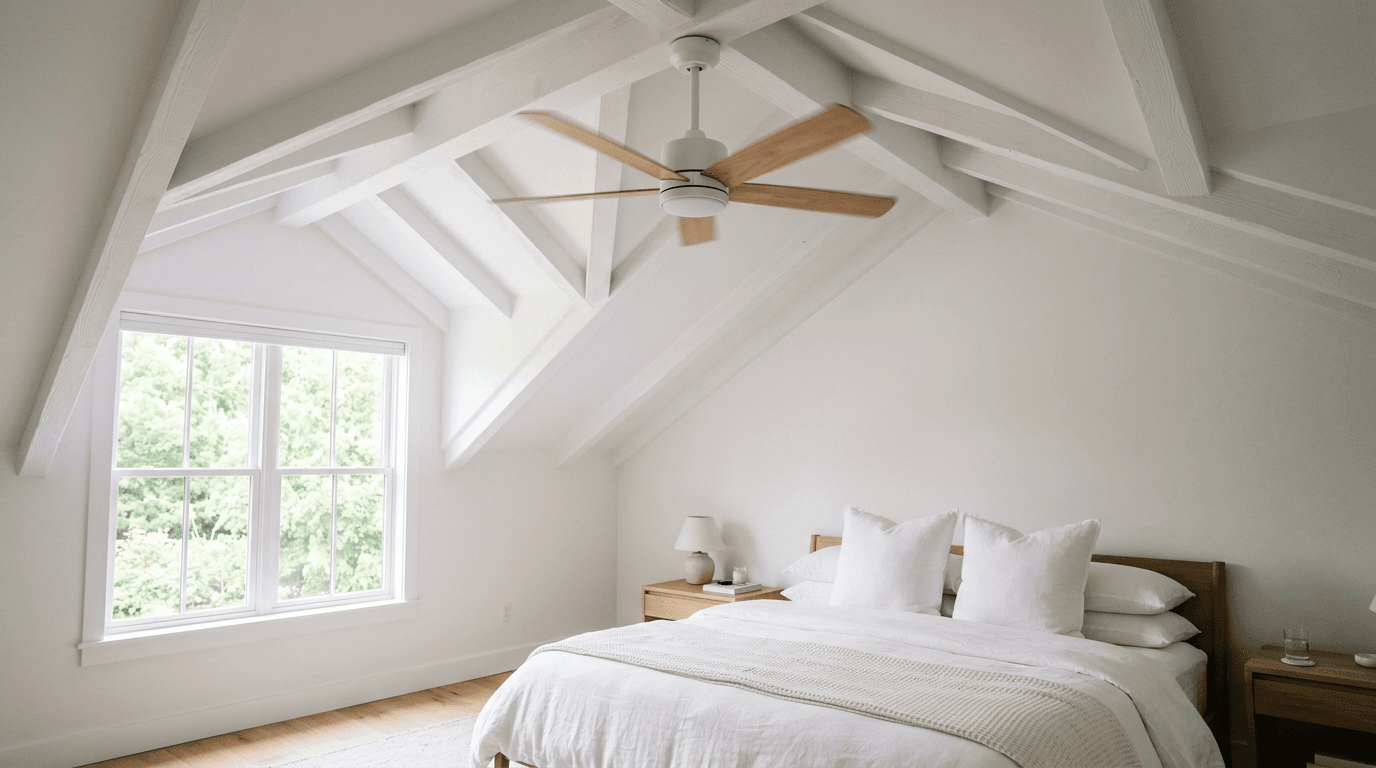
A ceiling fan does two things most people don't fully appreciate: in summer it makes a room feel 4–6 degrees cooler (letting you raise the thermostat without sacrificing comfort), and in winter, running it slowly in reverse pushes warm air that's pooled at the ceiling back down to where people are sitting. Done right, ceiling fans meaningfully lower energy costs. Done wrong — wrong size, wrong mount, wrong location — they move air poorly and just add visual clutter.
Short answer: match the fan blade span to the room square footage, pick the right mount for your ceiling height, and make sure the electrical box is fan-rated before anything gets installed.
The Most Common Mistake: Buying Too Small
Walk through any big-box store and the fans on the low shelves look perfectly fine — until you put a 42-inch fan in a 20x20 living room and wonder why nothing feels different. Fan sizing is straightforward once you know the rule.
Room Size to Fan Blade Span
| Room Size (sq ft) | Recommended Blade Span | Typical Rooms |
|---|---|---|
| Up to 75 sq ft | 29–36 inches | Small bathroom, small office, walk-in closet |
| 76–144 sq ft | 36–42 inches | Standard bedroom, small office |
| 145–225 sq ft | 44–50 inches | Large bedroom, master suite, kitchen/dining |
| 226–400 sq ft | 52–60 inches | Living room, great room, open-plan area |
| Over 400 sq ft | 60–72 inches, or two fans | Large great rooms, vaulted open plans |
For very large rooms or rooms with unusual shapes, two mid-size fans often circulate air more evenly than one oversized unit. We'll tell you honestly if your room falls into that category.
Ceiling Height and Mount Type
The goal is to keep the fan blades at least 7 feet above the floor — any lower creates a safety issue and reduces circulation efficiency. The right mount depends entirely on your ceiling height.
Standard Mount (downrod) The default mount for ceilings 8 feet and above. The fan hangs on a short downrod, keeping blades at a safe height while allowing good airflow. Most Rockland County colonials, ranches, and split-levels have 8-foot ceilings — standard mount is correct for these.
Flush Mount (hugger) For ceilings under 8 feet, a flush-mount fan sits directly against the ceiling without a downrod. Airflow is somewhat reduced compared to a fan that hangs lower, but it's the right call for low-ceiling rooms. Many older Cape Cods and bungalows in areas like Haverstraw, Stony Point, and Congers have rooms that benefit from flush-mount fans.
Extended Downrod For ceilings over 9 feet — vaulted great rooms, two-story entries — an extended downrod brings the fan down to the ideal 8–9 foot operating height. Without the downrod, a fan on a 12-foot ceiling barely moves the air where people are. Downrod length is calculated from the ceiling height; we keep common lengths in stock.
Room-by-Room Guide
Living Rooms Go larger — 52 inches or more for most living rooms. A light kit is almost always worth adding so the fan handles both air circulation and ambient lighting. If your living room has a ceiling over 9 feet, factor in downrod length. For open-plan spaces in newer New City or Nanuet homes where the living room flows into the kitchen, consider a 60-inch fan or two coordinated fans.
Bedrooms Noise matters more in a bedroom than anywhere else in the house. DC motor fans run significantly quieter than older AC motor models and use less electricity. Remote controls or wall controls that manage fan speed and light separately are worth the small premium. Most standard bedrooms (under 200 sq ft) are well-served by a 44–52 inch fan.
Kitchens Fans above a kitchen table or island work well — 36–44 inches for a typical kitchen, positioned over the seating or eating area, not directly over the stove. Avoid mounting a fan too close to the cooktop; grease accumulates in the motor over time.
Covered Porches and Outdoor Areas This is where fan selection matters most from a durability standpoint. Outdoor fans are rated in two categories:
- Damp-rated — Safe for covered porches and patios where the fan isn't directly hit by rain. This is the right choice for most screened porches or covered decks in Rockland County.
- Wet-rated — Required for areas exposed directly to rain or sprinklers. A pergola without a solid roof, or a poolside installation, needs a wet-rated fan.
Installing an indoor fan outside voids the warranty and creates a fire hazard as the motor corrodes. Always check the rating on the box.
Motor Types: AC vs. DC
Most fans sold in home improvement stores use AC motors — reliable, widely available, and affordable. DC motor fans cost more upfront (typically $40–$100 more) but run quieter, have more speed settings, and use about 70% less energy. For a bedroom or home office where you'll run the fan for hours, the DC motor pays for itself over time.
Light Kits and Controls
Most ceiling fans accept a light kit if they don't come with one, though we recommend confirming compatibility before buying separately. LED light kits are the standard now — they run cool and last years.
Controls options: - Wall switch — Simple on/off; requires compatible wiring. A separate switch for the light and fan is ideal. - Remote control — Convenient, especially when the fan is centered on a vaulted ceiling far from a switch. Most remotes clip into the canopy. - Smart controls — Some fans integrate with Alexa, Google Home, or Apple HomeKit. Others work with a smart wall switch. If smart home integration matters to you, check compatibility before buying. See our smart home setup guide for context.
Why Fan-Rated Electrical Boxes Matter
This is the detail that gets skipped in DIY installations and causes real problems. A standard electrical box — the kind used for a light fixture — is designed to hold a static load of 35–50 pounds. A ceiling fan adds dynamic load: the motor vibrates, the blades spin, and over time a non-rated box works loose from the framing. In the worst cases, the fan comes down.
A fan-rated box is designed to support 35–50+ pounds of dynamic load and is mounted directly to the ceiling joist or a brace rated for the weight. If your existing box isn't fan-rated, it needs to be replaced before the fan goes up. This is one of the primary reasons professional installation is worth doing — we check the box before anything else. You can learn more about what goes into a proper installation on our ceiling fan installation and replacement service page.
Typical Ceiling Fan Installation Costs in Rockland County (2026)
| Scenario | Typical Cost Range |
|---|---|
| Replace existing fan (fan-rated box, same location) | $85–$150 labor |
| New fan where light fixture existed (box replacement needed) | $120–$200 labor |
| Flush-mount install (low ceiling) | $85–$150 labor |
| Extended downrod install (vaulted ceiling) | $120–$185 labor |
| Outdoor fan on covered porch | $100–$175 labor |
These ranges reflect typical 2026 labor rates in Rockland County and don't include the cost of the fan itself. They are general estimates, not a quote. See our full [handyman pricing guide](/blog/rockland-county-handyman-pricing-2026) for more detail.
Frequently Asked Questions
What size ceiling fan do I need for a 12x14 bedroom? A 12x14 room is 168 square feet. That falls in the 145–225 sq ft range, so a 44–50 inch fan is the right fit. A 42-inch fan will work but won't circulate air as effectively.
Can a handyman install a ceiling fan, or does it require an electrician? A handyman can install a ceiling fan on an existing circuit — swapping a fan for a fan, or replacing a light fixture with a fan (assuming the box is fan-rated or is upgraded to one). Running a new circuit or adding a dedicated switch where no wiring exists requires a licensed electrician.
How do I know if my ceiling box is fan-rated? Look inside the canopy once the old fixture is down. A fan-rated box is typically stamped "Acceptable for Fan Support" or similar. If there's no marking, or if the box wiggles when you push it, assume it isn't rated and have it replaced before installing the fan.
My ceiling fan wobbles — is that dangerous? A small amount of wobble at high speed is often a blade balance issue, fixed with a balancing kit (usually included with the fan). Significant wobble at any speed usually means the mounting isn't secure — a loose canopy, an improperly installed downrod, or an inadequate electrical box. That should be addressed promptly.
What's the best ceiling fan brand? Hunter, Minka-Aire, Progress Lighting, and Casablanca are well-regarded. For DC motor fans in the mid-range, Monte Carlo and Big Ass Fans (for larger rooms) stand out. We don't have brand allegiances — we'll install whatever you've selected or help you choose based on your room and budget.
Should the ceiling fan run clockwise or counterclockwise in winter? In winter, set the fan to run clockwise at low speed. This pulls cool air up and pushes warm air that's collected near the ceiling down along the walls — effective in rooms with ceilings over 8 feet. Most fans have a direction switch on the motor housing or in the remote app.
Get Your Ceiling Fan Installed Right the First Time
We install ceiling fans throughout Rockland County — New City, Nanuet, Nyack, Pearl River, Suffern, Spring Valley, Haverstraw, and everywhere in between. Call or text (908) 461-2688 or request a free estimate and we'll take care of everything from box inspection to final spin test.
Odds & Ends Handyman Service is a licensed Rockland County Home Improvement Contractor (#H-25-600), insured for $1,000,000, and in business since 2001 — serving the Town of Tuxedo, including Tuxedo Park, and all of Rockland County, NY.
Related