
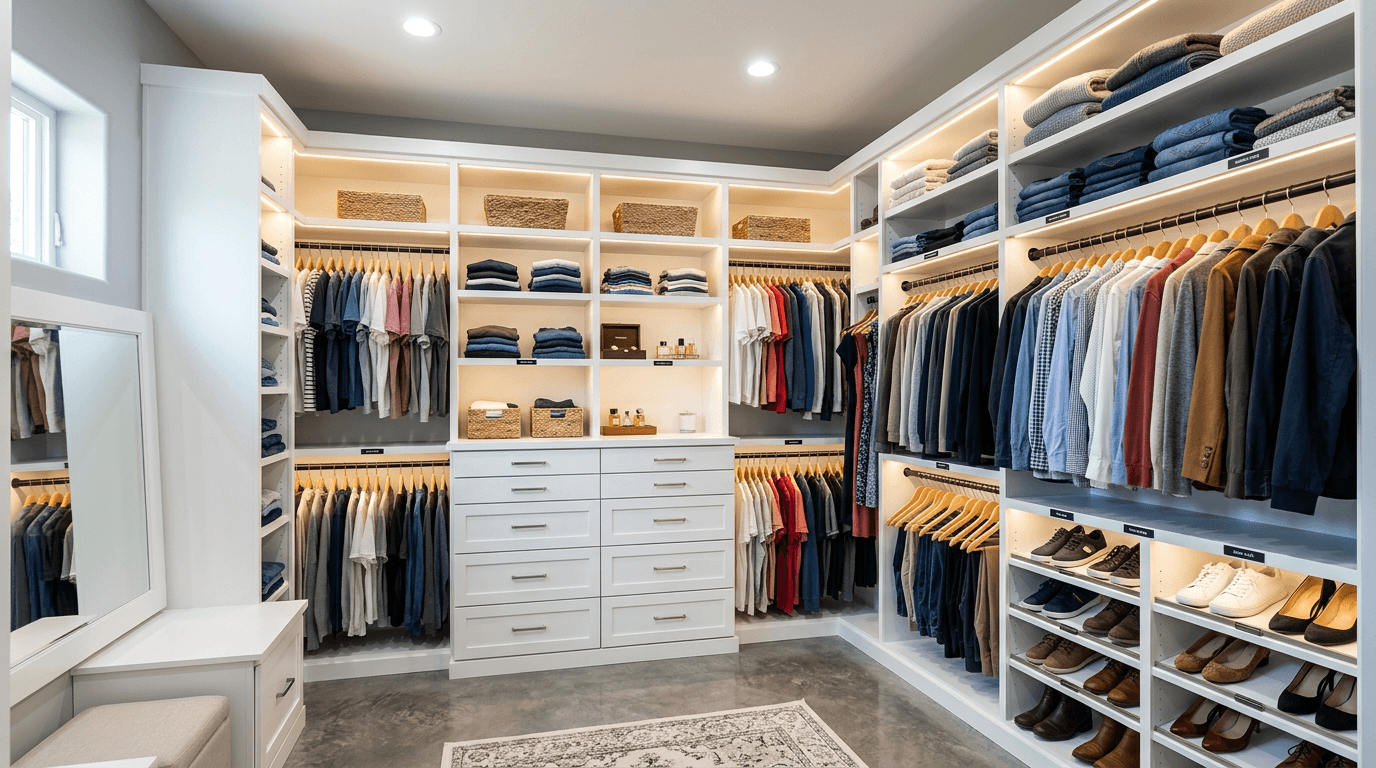
Most reach-in closets come from the builder with one rod and one shelf. That setup uses perhaps 40 percent of the available space and forces everything into a single hanging layer. Meanwhile, your floor becomes a pile of shoes, your shelf becomes an unstable tower of folded items, and getting dressed in the morning is harder than it should be.
Short answer: A properly designed closet system — even a mid-range laminate kit — can double or triple your usable storage in the same footprint. Professional installation ensures it is level, anchored into studs, and actually square to walls that rarely are.
The Real Problem With Builder Closets
The single-rod-and-shelf configuration was never designed for efficiency. It was designed to be installed in ten minutes at minimal cost. Consider what that standard setup typically wastes:
- The space above the shelf (often 12–18 inches to the ceiling) is dead space
- The floor below hanging items is used only as a dump zone
- There is no double-hanging section, so short items like shirts occupy the same vertical space as full-length dresses
- There are no drawers, so folded items live in piles on the shelf or floor
A well-planned system addresses all of these at once, and the investment pays off in daily quality of life.
Wire, Laminate, or Custom Wood: Which Is Right for You?
| System Type | Best For | Typical Cost Range | Pros | Cons |
|---|---|---|---|---|
| Wire (ClosetMaid, Rubbermaid) | Utility closets, linen closets, pantries | $ (lowest) | Good airflow, easy to reconfigure, widely available | Purely functional appearance; items can tip through wire |
| Laminate (IKEA PAX, Rubbermaid Configurations, ClosetMaid Selectives) | Bedroom closets on a budget | $$ (mid-range) | Clean appearance, solid shelf surface, modular | Heavier; more complex to install; limited custom sizing |
| Custom wood / MDF with finish | Master bedroom closets, investment properties | $$$ (highest) | Exact dimensions, drawers/pull-outs, premium look, adds resale value | Higher material and labor cost |
Wire Systems
Wire is the right choice for utility spaces: laundry rooms, linen closets, hall closets, pantries. The open grid allows air circulation (important for linen storage) and means you can reposition shelves and rods without tools in most systems. They look utilitarian, but in a pantry or utility space, that is perfectly appropriate.
We install a lot of wire systems in the older homes throughout Nyack, Piermont, and Tappan — many of which have shallow, irregularly shaped closets in older plaster-and-lath construction. Wire systems flex well to odd dimensions.
Laminate / Modular Systems
Brands like IKEA PAX, ClosetMaid Selectives, and Rubbermaid Configurations occupy the middle ground. They offer a finished appearance with solid shelving surfaces, and most include tower units with optional drawers. IKEA PAX in particular offers an enormous range of configurations and accessories.
These systems require more careful planning and more precise installation. The modules need to be level, plumb, and anchored securely — IKEA's own assembly instructions acknowledge that walls may not be flat or square, and that gap-filling and shimming are expected steps. If you have ever seen a PAX wardrobe that leans slightly or has a visible gap at the ceiling, it was installed without accounting for those tolerances.
Custom Wood and MDF Systems
A built-to-order closet system — whether ordered through a closet company or built by a carpenter — is sized exactly to your space and can incorporate features like pull-out shoe trays, velvet-lined jewelry drawers, and integrated lighting. In Rockland County, these systems add measurable appeal when selling a home, particularly in master bedrooms of higher-priced listings in New City, Montebello, or Chestnut Ridge.
The closet system installation service we offer covers all three types.
How to Maximize Every Type of Closet
Reach-In Bedroom Closets
The most impactful change in a standard reach-in is adding a double-hang section: two rods stacked vertically, each carrying shirts, jackets, or folded pants. A typical reach-in closet (6 feet wide, 8 feet tall) configured well might include:
- Double-hang section (shirts and jackets) — 30–36 inches wide
- Single-hang section for dresses or long pants — 24 inches wide
- Tower unit with shelving and optional drawers — 18–24 inches wide
- Floor-level shoe storage below the hanging sections
That layout can comfortably serve two people's wardrobe in what originally felt like a tight space.
Walk-In Closets
Walk-in closets benefit from an L- or U-shaped perimeter layout that uses every wall. Center islands are attractive but realistically only make sense in larger walk-ins (10 x 10 feet or larger). For most Rockland County homes with a modest walk-in, maximizing the perimeter with a mix of hanging, shelving, and drawers is the right call.
Linen and Hall Closets
These benefit most from adjustable shelving at multiple heights rather than fixed shelves at standard intervals. Towels, bedding, and cleaning supplies all have different heights. Add pull-out baskets on lower shelves for easy access to smaller items.
Pantry Closets
Pantry organization is about accessibility as much as capacity. Key features:
- Adjustable shelving at close intervals (every 6–8 inches) so canned goods stack without wasted vertical space
- Pull-out drawers or baskets at knee level and below (much easier than reaching to the back of a fixed shelf)
- Door-mounted racks for spices, foil, and wrap products
- Clear bins labeled by category
Why Professional Installation Matters
This is not false modesty — walls in most homes are not plumb, floors are not level, and corners are not square. A closet system installed without accounting for these realities ends up with visible gaps, shelves that slope, and towers that lean. In older homes in river towns like Nyack, Piermont, and Tappan, plaster-and-lath walls have additional irregularities that make accurate shimming and leveling even more important.
Professional installation also means anchoring into studs wherever possible, and using appropriate hollow-wall anchors where studs do not align. A loaded clothes rod — carrying 40 pounds of winter coats — needs to be anchored to something structural, not drywall paper. A wire shelf system ripped from the wall is a frustrating failure that damages the wall and requires repair before reinstallation. We have fixed that scenario more than once.
See also: how to hire a trustworthy handyman near you for what to look for when bringing someone into your home.
Typical 2026 Pricing in Rockland County
| Project Scope | Typical Range |
|---|---|
| Wire system, single reach-in closet (labor only, materials extra) | $120–$220 |
| Laminate modular system, single reach-in (labor only) | $175–$350 |
| IKEA PAX wardrobe, 2-section (labor only, customer-supplied) | $150–$275 per unit |
| Walk-in closet full system (labor only, mid-range materials) | $400–$900 |
| Pantry or linen closet rewire/reshelf | $100–$200 |
These are general estimates for 2026 Rockland County labor rates, not a quote for your project. For a full breakdown, see our [Rockland County handyman pricing guide](/blog/rockland-county-handyman-pricing-2026) or [request a free estimate](/estimate).
Material costs vary widely — a wire system for a single closet might run $40–$100 in materials; a full laminate walk-in system can run $500–$1,500 in materials depending on the brand and features chosen.
Frequently Asked Questions
What closet system brand do you recommend for a master bedroom?
For a budget-conscious master bedroom, IKEA PAX or ClosetMaid Selectives offer the best balance of appearance and cost. For a longer-term investment or if you are planning to sell, a custom MDF system from a closet specialist or a quality modular wood system is worth considering. We can install any brand you source.
Can you install IKEA closet systems?
Yes. IKEA PAX and other flat-pack closet components are among the systems we install regularly. See our furniture assembly service for flat-pack work generally, and our closet system installation page for full closet builds.
How do you anchor closet systems when studs do not line up?
We use rated hollow-wall anchors (toggle bolts or snap toggles) for shelves and rods that cannot reach a stud. For heavier loads — especially hanging rods that will carry coats or winter gear — we install a horizontal cleat anchored across multiple studs, then hang the rod from the cleat. This is the correct approach and significantly stronger than direct hollow-wall anchoring.
Will a new closet system help my home sell faster?
An organized, well-installed closet makes a strong impression at showing. Buyers notice closet space, and a clean system signals that storage is adequate. Combined with other pre-listing improvements, it contributes to perceived value. See our post on common handyman jobs before selling a home for the full picture.
How long does closet installation take?
A single reach-in closet typically takes two to four hours. A full walk-in with a mix of hanging sections, shelving towers, and drawers may take a full day. We will give you a time estimate when we review the scope.
Do you handle the planning and layout, or do I need to figure that out first?
We can help with basic layout planning during the estimate — we will measure the space and walk through the configuration options. For complex or high-end custom systems, a dedicated closet design consultation (some closet companies offer these free) may be worth doing first so you arrive with a confirmed spec.
Ready to Reclaim Your Closet Space?
We serve all of Rockland County — Suffern, Spring Valley, Nanuet, Pearl River, New City, Nyack, and everywhere in between. Call or text (908) 461-2688 or request a free estimate to get started. We handle everything from a single wire reach-in to a full walk-in build-out.
Odds & Ends Handyman Service is a licensed Rockland County Home Improvement Contractor (#H-25-600), insured for $1,000,000, and in business since 2001 — serving the Town of Tuxedo, including Tuxedo Park, and all of Rockland County, NY.
Related