
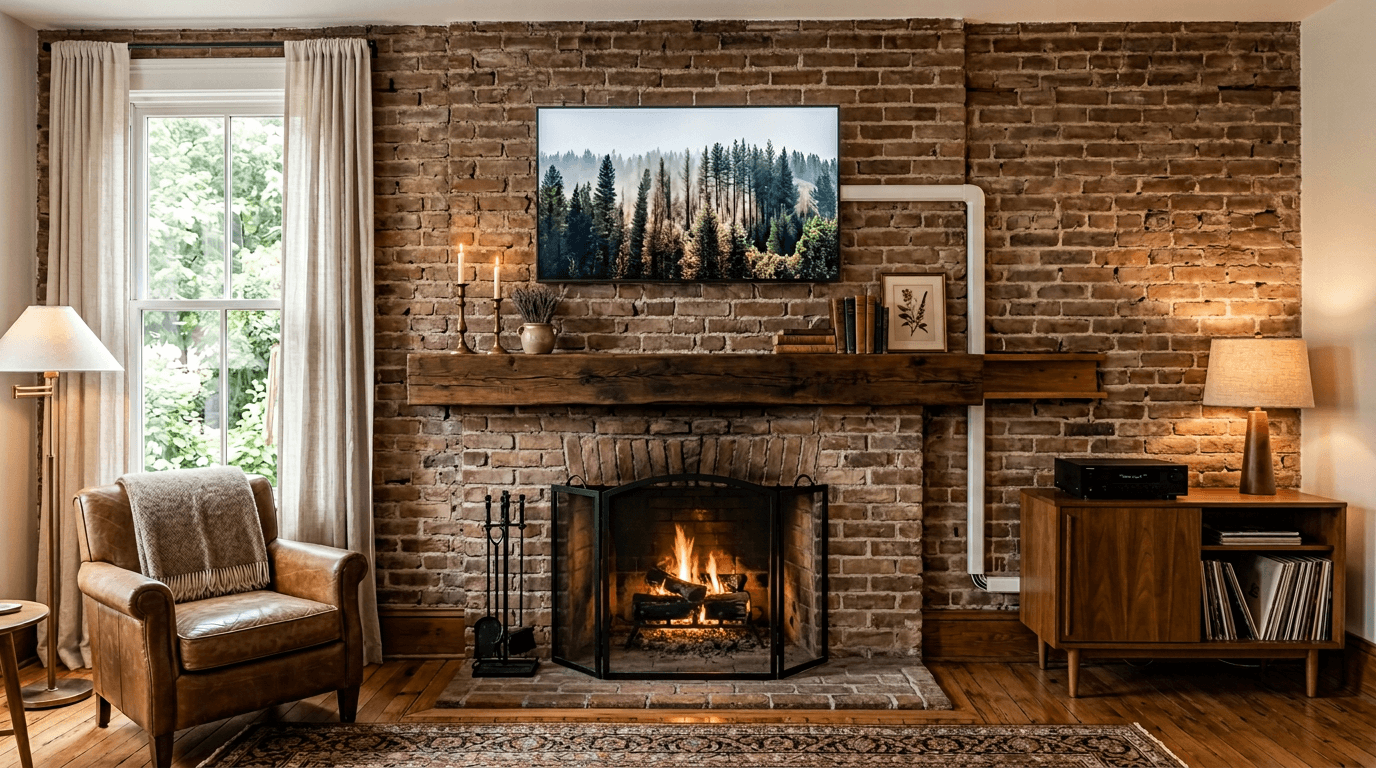
Mounting a flat-screen sounds like a 20-minute job — until the wall is 90-year-old plaster, the only logical spot is above a fireplace, and the cables have to disappear. Older homes in Rockland County reward a little planning here.
Short answer: in an older home, the best place to mount a TV is a flat interior wall where you can hit at least one stud, at a height where the center of the screen sits roughly at seated eye level. Avoid mounting over a working fireplace if you can, and budget extra time for plaster-and-lath walls, which need toggle bolts rather than standard drywall anchors.
Know Your Walls: Plaster vs. Drywall
This is the single biggest factor in an older Rockland County home. Houses built before about 1960 — common in Nyack, Piermont, Tappan, and the older sections of New City — were finished in plaster over wood lath, not drywall.
Plaster matters because:
- It is hard and brittle — driving the wrong anchor cracks it.
- Wood lath strips behind the plaster give false readings on a magnetic or basic electronic stud finder.
- Standard drywall anchors do not hold reliably in it.
A secure plaster mount means locating the real framing, anchoring into studs where possible, and using toggle bolts rated well above the TV's weight for the points that fall between studs. It is very doable — it just is not the same job as drywall, and a mount done with the wrong hardware is a genuine safety hazard. The same principle applies to hanging heavy mirrors and gallery walls.
The Best Place to Mount a TV, Room by Room
Living room
Pick the wall that gives the most comfortable, glare-free view from where you actually sit. The ideal mounting height puts the center of the screen at roughly seated eye level — for most people that is lower than instinct suggests. A flat, low-profile mount works when the view is straight-on; a tilting or full-motion mount helps when the only good wall is higher or off to the side.
Bedroom
Bedrooms are usually smaller, and wall-mounting frees the floor and kills the bulky dresser-top setup. Mount lower than a living-room TV — the screen center should land at eye level when you are propped up in bed, not sitting in a chair.
Kitchen and dining areas
Smaller kitchen TVs are popular for morning news and recipes, but older kitchens fight you with cabinets, tile backsplashes, and limited wall space. An under-cabinet mount, or a swing-arm mount on an adjacent wall, keeps the screen visible without giving up counter space.
Should You Mount a TV Over the Fireplace?
It is the most-requested spot and the most-debated one. The honest take:
- The downside: above a working fireplace the screen often ends up too high (neck strain), and rising heat can stress the electronics over time.
- When it works: if the fireplace wall is genuinely the only option, a full-motion mount that pulls out and angles down fixes the viewing angle, and proper heat clearance addresses the warmth. Decorative or rarely-used fireplaces are far less of a concern.
If you have a comparable adjacent wall, it is usually the more comfortable choice. If you do not, it is a solvable problem with the right mount.
Hiding the Wires in an Older Home
Cable concealment is what separates a clean install from a dangling-cord eyesore. Two routes:
- In-wall concealment — running the cables (and ideally adding a recessed power outlet behind the TV) inside the wall cavity. In plaster-and-lath walls this takes more care: there can be old pipes, knob-and-tube wiring, and horizontal fire blocking in the bay you are trying to fish.
- Surface raceway — a paintable channel that covers the cords on the wall surface. Less invasive, and a good choice when in-wall routing is not practical.
A pro checks what is in the wall before cutting. We have mounted hundreds of TVs across Rockland County and know what tends to be hiding behind plaster in homes around Suffern, Stony Point, and Tappan.
How Much Does TV Mounting Cost in Rockland County?
Typical 2026 ranges from real Odds & Ends jobs. Full detail is in our 2026 handyman pricing guide.
| TV mounting scenario | Typical 2026 price | Time on-site |
|---|---|---|
| Standard drywall, 32–55 in, customer bracket | $185–$235 | 1.0–1.5 hr |
| Drywall, 65–75 in, customer bracket | $235–$310 | 1.5–2.0 hr |
| Plaster-and-lath walls (pre-1960 home) | add $60–$100 | add 0.5 hr |
| Brick or stone fireplace (masonry anchors) | $310–$425 | 2.0–2.5 hr |
| In-wall cable concealment add-on | add $120–$180 | add 0.75 hr |
| Recessed power outlet behind the TV | add $140–$200 | add 1.0 hr |
The biggest cost driver in older homes is wall material — plaster walls run roughly 30% longer because of the careful drilling and toggle-bolt mounting that will not crack the plaster.
Frequently Asked Questions
Can you mount a TV on a plaster wall?
Yes. Plaster-and-lath walls — standard in pre-1960 Rockland County homes — hold a TV securely when the mount is anchored into the wood framing where possible and uses toggle bolts rated above the TV's weight for any point between studs. The keys are locating the real studs (basic stud finders misread behind lath), pre-drilling to avoid cracking the plaster, and using the right hardware. It is not a drywall job, but it is very routine for an experienced installer.
How high should a TV be mounted?
As a rule, the center of the screen should sit at eye level from where you normally watch — roughly seated eye level in a living room, and lower in a bedroom where you watch lying down. Mounting too high (the classic over-the-fireplace mistake) causes neck strain. A tilting or full-motion mount lets you correct the angle if the wall forces a higher position.
Is it bad to mount a TV over a fireplace?
It can be. Over a working fireplace the screen is often too high for comfortable viewing, and rising heat can stress the electronics. If the fireplace wall is the only option, a full-motion mount that angles the screen down, plus proper heat clearance, makes it work. If you have a comparable adjacent wall, that is usually the better choice.
How much does it cost to mount a TV in Rockland County?
In 2026, a standard drywall mount for a 32–55 inch TV typically runs $185–$235, and a 65–75 inch TV $235–$310, with a customer-supplied bracket. Plaster walls add roughly $60–$100, a brick or stone fireplace runs $310–$425, and in-wall cable concealment adds $120–$180. See our full pricing guide for the complete breakdown.
Can a handyman mount a TV?
Yes — TV mounting is standard handyman work on drywall, plaster, brick, and stone, including cable concealment. It does not require a specialty trade unless new electrical wiring is involved. See our TV mounting service and the full list of handyman jobs.
Get Your TV Mounted Right
Send a photo of the wall and the TV with a free estimate request, or call or text (908) 461-2688. We bring the right hardware for your wall type — drywall, plaster, brick, or stone — and leave everything level, secure, and cord-free.
Odds & Ends Handyman Service is a licensed Rockland County Home Improvement Contractor (#H-25-600), insured for $1,000,000, and in business since 2001 — serving the Town of Tuxedo, including Tuxedo Park, and all of Rockland County, NY.